A complete working library for servers, apps, data, documents, content, media and automation, with copyable prompts and clear completion checks.
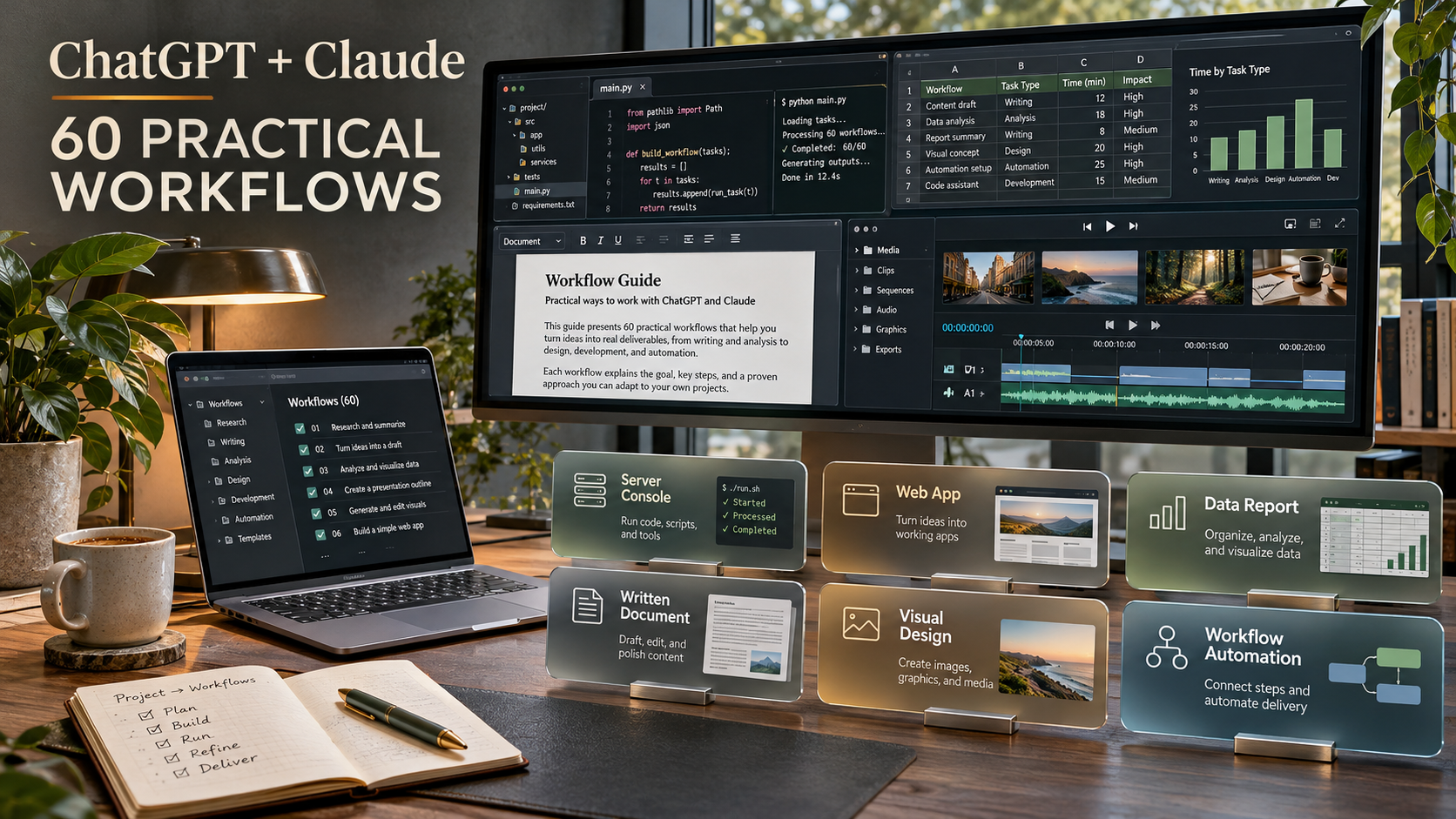
Documentation reviewed: November 18, 2026. A practical reference for readers who want finished work they can inspect: a running application, a cleaned spreadsheet, a report, a design asset or a rendered video.
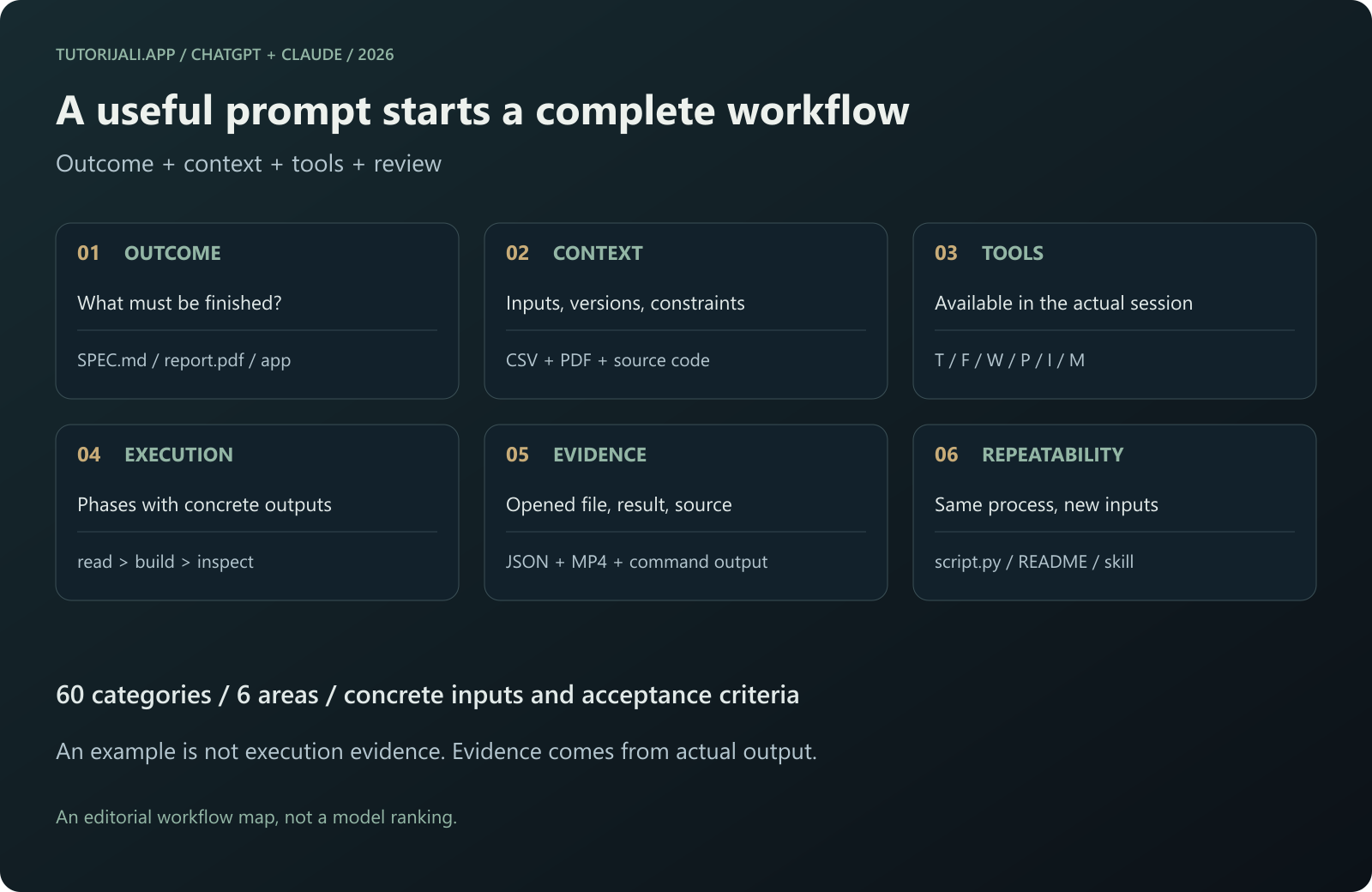
ChatGPT and Claude can help carry an idea through planning, implementation and review. How much they can finish depends on your materials, the tools enabled in the conversation and access to the target system. This guide covers 60 categories. Each explains the task, the inputs to provide, a reusable prompt and the evidence that would demonstrate success.
The useful instruction describes an outcome, context, permitted actions and a completion check. “Set up a server” leaves most decisions unresolved. “Prepare an Nginx reverse proxy for this existing application, validate the configuration and preserve a rollback path” defines work that can be reviewed.
The supplied research package also includes three worked examples: a Linux inventory, a synthetic order analysis and a rendered MP4 animation. Their original evidence remains available separately from the publication assets. These are not 60 independently executed experiments or a benchmark comparing ChatGPT with Claude.
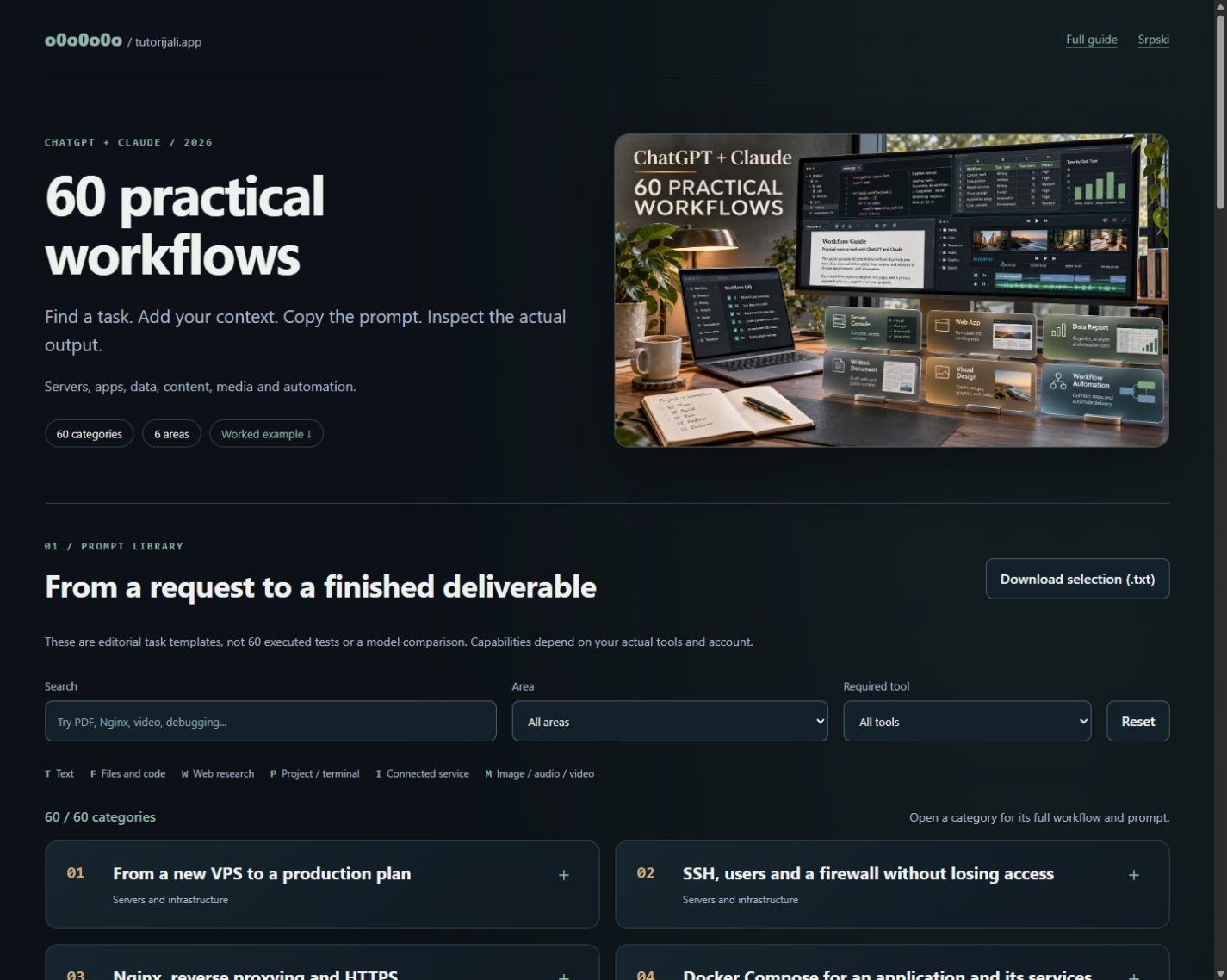
Use this as a working library: search all 60 prompts, filter by field or tool, copy an example and adapt its placeholders. Download the bilingual package.
Check the tools before choosing a workflow
A text conversation can write a configuration. Applying it requires a terminal, filesystem or supported integration. An attached PDF supports analysis of the content the system can actually read. A calendar task needs a connected account and a supported action.
OpenAI documents Chat, Work and Codex as different working surfaces. Anthropic documents Claude Code, code execution, Artifacts and connectors separately. Availability depends on the product, plan, organization settings and rollout. Check the tools in your actual session before assuming a file can be created or a system changed. Use ChatGPT, Claude tool use, Claude Code.
| Code | Requirement | Useful fallback when unavailable |
|---|---|---|
| T | Text work on supplied context | Explanation, plan, draft or code to use manually |
| F | File access or creation, with code execution where needed | Source content and commands, with no claim that a file was created or executed |
| W | Current source research | A list of facts to verify, without invented current information |
| P | Access to the project, terminal or target server | Proposed changes and an application procedure |
| I | A connected service, plugin, connector or browser | A draft or export for manual entry |
| M | An image, audio or video tool | A brief, script or code-rendered asset where supported |
These are prerequisites, not scores. “T + F” means a text model can design the procedure, while a finished file needs the appropriate environment.
Three different meanings of video
Generated footage, animation built from code and editing existing footage are different workflows. The OpenAI documentation says Sora 2 and the Videos API were shut down on September 24, 2026; its retained examples are historical guidance. OpenAI video documentation.
Claude Motion is a beta feature on Team and Enterprise plans at this review date. It creates animations from code and exports MP4; it does not generate realistic footage or people. Claude Motion.
A separate service can generate footage when an authorized tool and account are available. Google's current guide points to Gemini Omni Flash and marks Veo 3.1 Preview models as retired. Access, billing and limits belong to that service. A prompt in an arbitrary chat does not by itself establish access to a video generator. Google video documentation.
Adapt the prompt to your actual task
Replace bracketed placeholders with your own facts. If you do not know the operating-system version, say so and request a read-only command to identify it. Use an existing authorized connection or secret manager for server access; passwords and private keys do not belong in a public article or repository.
Goal: [specific outcome]. My experience: [beginner/intermediate/advanced].
Context, versions and source materials: [describe or attach].
Permitted work: [analysis / local changes / access to a named system].
Deliver: [exact files, formats or implemented change].
Identify only missing information that affects correctness.
Make routine decisions independently and record material assumptions.
Use the available tools and check the result appropriately.
Separate work actually executed from proposals and unverified steps.
Use current primary documentation for facts that change over time.
A role such as “senior administrator” can guide the tone. It cannot replace a version number, service name or acceptance criterion. Ask for useful decision explanations and inspectable outputs rather than a special phrase or private internal reasoning.
| Area | Categories | Typical deliverable |
|---|---|---|
| Servers and infrastructure | 01-10 | Configuration, diagnosis, migration and recovery procedure |
| Application development | 11-20 | Specification, working code, checks and release workflow |
| Data and documents | 21-30 | Clean data, calculated report, document or presentation |
| Content, communication and learning | 31-40 | Researched writing, business communication and learning material |
| Images, design, audio and video | 41-50 | Visual asset, prototype, animation, edit or subtitles |
| Everyday work and automation | 51-60 | Comparison, personal tool, integration or repeatable workflow |
Servers and infrastructure
A normal chat can provide commands and configuration. Working on your VPS requires authorized access. Claude Code and OpenAI's coding workflows document ways to read projects, edit files and execute commands. The product name alone does not grant access to a server. Claude Code, OpenAI code generation.
From a new VPS to a production plan
Requirements: T + W; P to apply changes. Level: intermediate, accessible to a beginner with explanations.
A useful plan identifies services, data locations, public ports and recovery steps for a specific application. An occupied server needs a different procedure from an empty machine. Provide the distribution, resources, domain, stack, persistence model and acceptable downtime.
My VPS runs [distribution/version] with [resources]. It must host
[application/versions] at [example.com]. Current state: [description].
Create an operational plan covering users, directories, service management,
public ports, reverse proxy, HTTPS, configuration and backups.
Start with read-only inventory commands. Then provide files with full paths,
explain every change, order the deployment and check the app locally and
externally. If an authorized terminal is available, execute the agreed scope
and save evidence; otherwise deliver a complete manual deployment package.
Check: application restart, a test-environment reboot and domain access must preserve the expected behavior. “Ready” without those observations is insufficient. A useful next step is versioned infrastructure that can recreate another instance.
SSH, users and a firewall without losing access
Requirements: T + W + P. Level: intermediate.
Changing SSH and firewall rules can sever the only administrative connection. Establish the actual port, administrator account and provider-console access first. Provide redacted configuration, distribution, current rules and required public services.
Configure key-based access for [account] on my VPS and allow only
[services/ports] through the firewall. Existing SSH port: [port/unknown].
Inspect the current state and prepare minimal distribution-specific changes.
Validate configuration before reloading. Test a new connection in a second
session before removing the previous login method. For every command,
state its precondition and rollback step. An existing session staying open
does not prove that a new connection will work.
Check: a genuinely new session must work, and exposed ports must match the requested list, including the relevant IPv6 path. Consider a separate administrative network next. A universal configuration can miss provider-specific rules.
Nginx, reverse proxying and HTTPS
Requirements: T + W; P for installation and verification. Level: intermediate.
Include domains, redirects, WebSockets, upload limits and forwarded headers. First establish that the application answers on its internal port. Provide server blocks, DNS state and actual upload or long-connection requirements.
Prepare an Nginx reverse proxy from [example.com] to 127.0.0.1:[port].
Requirements: HTTPS, [WebSockets yes/no], uploads up to [size].
Match the installed Nginx version and existing sites. Check upstream and DNS
first. Deliver configuration, a syntax check, certificate issuance/renewal
steps and curl checks. State expected HTTP/HTTPS statuses and headers.
Explain how to distinguish 502, a timeout and an application-originated error.
Check: syntax, HTTPS and certificate renewal. Redirects must not loop behind another proxy. Add a CDN only for a defined need, including a documented way to establish the client's real address.
Docker Compose for an application and its services
Requirements: T + W + F; P to run it. Level: intermediate.
A Compose project should describe dependencies, persistent data and failure behavior. A running container is not necessarily a ready application. Provide application instructions, environment-variable names without values and persistence paths.
Create Docker Compose for [application], PostgreSQL [version] and [service].
Keep the database on the internal network. Deliver compose.yaml, a secret-free
.env.example, health checks, persistent storage and a README covering startup,
updates and rollback. Explain data behavior during recreate and volume removal.
Parse the configuration using the available Compose version. If execution is
available, record application readiness and restart behavior.
Check: valid configuration, a real application response and test data surviving container recreation. Shutdown instructions must not silently delete volumes. Separate development and production settings with explained differences.
PostgreSQL schemas, indexes and permissions
Requirements: T + F; W for version details, P for database access. Level: intermediate/advanced.
Useful optimization starts with an actual query, schema and representative data volume. An index can increase write costs without helping the query. Provide a redacted schema, database version and anonymized execution plan.
Analyze this PostgreSQL schema and query for [goal/problem]. Propose the
smallest migration and separate application/migration roles. Explain integrity
constraints, indexes and concurrent writes. For each optimization, identify the
expected execution-plan change. Prepare sample data and before/after measurement.
Do not run a data-changing query for measurement without a suitable test environment.
Explain the cost of adding an index to an existing large table.
Check: integrity, application-role permissions and representative measurements. EXPLAIN ANALYZE executes the query, including modifying statements. A next step is slow-query analysis under actual load with sensitive parameters removed.
Backups you can restore
Requirements: T + W + F; P/I for automation. Level: intermediate.
Define acceptable data loss and recovery time. An archive can exist while being incomplete or unusable. Provide data sources, storage, size, change rate and recovery objectives.
Prepare backups for [database/directories], allowing at most [period] of data
loss and [time] to recover. Define consistent copying, encryption, destination
and retention. Deliver a script, schedule and failure notification without
repository secrets. Include a complete restore procedure on a separate instance
and checks of specific records/files. Separate transfer success from restore success.
Check: the application starts against restored test data in a separate environment. Include loss of the main account: a backup stored alongside production can share its failure. Periodic automated restore exercises are a useful extension.
DNS, domain connections and email delivery
Requirements: T + W; I/P for changes. Level: beginner/intermediate.
Combine registrar, DNS, hosting and email-provider information without removing records still in use. Provide authoritative nameservers, current records and official setup instructions.
Connect [domain] to [hosting] and [email service]. These are the existing DNS
records and provider requirements. Produce a table of name, type, value,
purpose and add/change/retain action. Check SPF, MX, CNAME and subdomain conflicts.
State expected public answers and commands for authoritative/recursive lookups.
After a test message arrives, inspect SPF/DKIM/DMARC headers without promising
inbox placement.
Check: expected DNS responses and headers of an actually received message. A lookup alone proves neither application health nor email reputation. Plan TTLs and preserve other services during migration.
Diagnose errors from logs
Requirements: T; F for larger logs, P for collection. Level: all levels.
Preserve timestamps, the period before and after the incident, recent changes and request IDs. A visible log error may be a consequence of an earlier fault. Provide redacted application/proxy logs and expected behavior.
At [time/timezone] the application started [symptom]. Attached are application
and proxy logs plus recent changes. Build a timeline and rank causes by evidence.
For each, give the cheapest discriminating check. Propose a minimal fix after
that check. Separate log facts from assumptions. If information is missing,
name the exact command or metric needed for the next decision.
Check: the original reproducible request works after the change; suppressing a message is not a fix. Keep the request and post-fix evidence. Add a regression check covering the identified cause where appropriate.
Monitoring and incident response
Requirements: T + W + F; P/I for connections. Level: intermediate.
For a small service, an accurate health endpoint and external check may be more useful than a large dashboard. Every alert needs an owner and an action. Provide services, the important user journey, baselines and notification channel.
Design minimal monitoring for [application]: external availability, the critical
user journey, disk usage and backup failure. Define units, thresholds and
waiting periods. Write a short runbook for each alert: confirm, investigate,
mitigate and close. Add a controlled test-environment failure to establish
that notifications arrive and recovery closes the alert.
Check: controlled failure and recovery produce the expected notifications. Replace guessed thresholds with observed baselines. Extend toward availability objectives and deduplication of repeated notifications.
Hosting migration and infrastructure costs
Requirements: T + W + F; P/I to execute. Level: intermediate/advanced.
Break costs into requests, execution, databases, transfer and storage. Subscription prices alone omit egress and operating work. Provide redacted invoices, traffic metrics, region, plan and acceptable downtime.
Analyze these infrastructure invoices for [period]. Link costs to metrics and
flag unexplained items. Compare staying, optimizing and migrating using current
regional prices. Show baseline, growth and peak scenarios with assumptions.
For the chosen option, plan a rehearsal, data synchronization, DNS change,
journey checks and rollback window. Include backups, monitoring and human work.
Check: trial import and functional requests on the new system precede the domain cutover. Show formulas and sources rather than a guaranteed cost. Controlled load testing belongs in your own test environment.
Application development
Finished software requires access to the project and a way to exercise it. A code answer can be useful, but completion means demonstrated behavior. The following workflows depend on available development and file tools rather than a promise that every interface has every feature.
Turn an idea into an implementable specification
Requirements: T + F for a document. Level: all levels.
“Build a CRM” leaves users, entities and rules undefined. Start with actual workflows and acceptance criteria. Provide the current process, representative examples and budget or infrastructure constraints.
I need an application for [job]. Users are [roles]; the current process is
[steps]. Write the specification for a first useful release. Define journeys,
entities, access rules and invalid-input behavior. Give an example input,
expected output and acceptance criterion per feature. Ask only questions that
block implementation. Deliver SPEC.md with scope, open decisions and build order.
Do not add a feature without a clear user and purpose.
Check: someone else can understand the product without the conversation history. Walk through normal, boundary and failure cases. Link requirements to implementation tasks and checks next.
Build a small functional web application
Requirements: T + F + P for project work. Level: beginner/intermediate.
Choose a complete small journey such as booking an appointment or tracking equipment. State whether data stays in one browser or is shared. Provide the specification, devices, sample records and sign-in requirements.
Build an app for [one clear journey]. Users must [three essential actions].
Store data [locally/in a database]; access rules are [description]. Follow the
existing stack, or explain a new-project choice. Deliver complete files,
.env.example, startup instructions and sample data. Include empty, error and
success states. Run available checks and exercise the main journey, including
refresh persistence. Identify prototype parts and what works within this scope.
Check: create, read, update and persistence work in the intended environment. A button that merely displays a success message is not the implemented journey. Add real authentication and a separate test database when needed.
API integrations and webhook receivers
Requirements: T + W + F + P. Level: intermediate.
Translate official documentation into authorization, mapping and error handling. Webhooks need authenticity checks and duplicate handling. Provide current documentation, a redacted request and the business outcome.
Integrate [service/API version] for [outcome]. Read current official docs.
Implement authorization, mapping, timeouts, rate-limit handling and clear errors.
Verify webhook signatures as documented and make processing idempotent.
Include sample events and checks for duplicates, invalid signatures and temporary
outages. Keep secrets in server configuration. Label simulated responses;
do not report them as production calls.
Check: replaying one event does not repeatedly change state. Use the provider's test mode. A next step is a retry queue with a trace connecting each event to its effect.
Fix a bug in an existing codebase
Requirements: T + F; P for reproduction. Level: all levels.
A small reproducible case is more useful than a screenshot alone. Provide the steps, expectation, observed result, relevant files and error trace.
Fix this project bug: [steps]. Expected: [outcome]. Actual: [result].
Reproduce it first or identify the exact reproduction blocker. Find the cause
and apply the smallest useful change. Recheck the original scenario and nearby
boundary. Add a regression test where it covers the real risk. Preserve style
and public interfaces unless change is necessary. Connect cause, fix and evidence
in the final report.
Check: perform the original action against the changed version. A successful build alone is insufficient. Investigate why previous checks missed it as a follow-up.
Test business rules and important journeys
Requirements: T + F + P. Level: intermediate.
Test value comes from consequences covered rather than file count. Consider duplicate clicks, time zones, interrupted dependencies and unauthorized users. Provide rules, existing checks and the most costly failure modes.
Create a validation plan for [module] using these business rules. Prioritize
[critical journeys]. Choose unit, integration or end-to-end checks by risk.
Implement a small meaningful set covering normal use, boundaries, dependency
failure and denied access. Demonstrate that the relevant regression check catches
the original fault, then run it on the fix. Separate environment instability
from product failures.
Check: report executed, failed and skipped cases. A test should not simply repeat the implementation's expression. A controlled rule mutation can reveal whether it detects incorrect behavior.
Review and refactor an existing project
Requirements: T + F + P. Level: intermediate/advanced.
Focus on a defined maintenance problem, such as three incompatible copies of one rule. Whole-project rewrites make review harder. Provide the target modules, purpose and public contracts.
Review [module/path] for [maintenance problem]. First report findings with
locations, consequences and examples. Propose the smallest refactor preserving
public behavior. Apply a coherent change and show effects on callers and
dependencies. Run relevant checks and identify uncovered behavior. Keep unrelated
formatting, new features and business-rule changes outside this refactor.
Check: representative inputs behave the same before and after; the diff is understandable to another person. If performance is the goal, measure with identical inputs and conditions.
Authentication, roles and data access
Requirements: T + W + F + P. Level: intermediate/advanced.
Hiding a button does not enforce access. Define which users can read or change each entity and how organizations stay isolated. Provide the role matrix and existing identity provider.
Implement access for [roles] in this application. Records belong to
[organization/project/user]. Define read/write permissions and enforce them
on the server and data layer using the existing authentication system.
Check direct API calls with the wrong role and another user's record ID.
Document session behavior, logout and permission changes.
Check: organization A cannot obtain organization B's records even with a known identifier. Extend with automated isolation checks and an audit trail for critical changes.
A PWA with useful offline behavior
Requirements: T + W + F + P. Level: intermediate.
Define “offline” per action: reading cached data, saving drafts and confirming server writes differ. Provide target browsers, data types and conflict rules.
Make [application] a PWA for [devices/browsers]. Offline actions: [list].
Online-only actions: [list]. Show connection state and distinguish a local
draft from a confirmed server record. Define the send queue, retries and
conflict resolution. Deliver the manifest, code and offline-check procedure.
Check app updates and stale-cache removal without losing local entries.
Check: disconnect during saving, reopen and reconnect. Local schema versioning is a useful next step. Do not claim installability on every platform without checking its requirements.
Build an interface from a reference
Requirements: T + F; M for image analysis, P to implement. Level: all levels.
A screenshot communicates layout rather than behavior. Provide actual content, states and device targets. Include keyboard access, focus, loading, errors and long names.
Build an original interface for [product] using this reference. Preserve
[important visual elements] and meet [readability requirements]. Include phone
and desktop layouts, real content, empty/loading/error states, semantic markup
and visible focus. Run it, check keyboard navigation and text overflow.
For screenshot comparisons, report resolution and remaining differences.
Deliver a working preview that can be opened and inspected.
Check: complete the main journey without a mouse and with enlarged text. Automated accessibility tools do not cover every barrier. Follow up with a screen reader and representative content.
GitHub, CI/CD and release preparation
Requirements: T + W + F + P; I for a remote repository. Level: intermediate.
Separate validation, build, migration, deployment and health confirmation. A successful CI job does not prove the public app uses the intended version. Provide current workflows, hosting and release rules.
Prepare this project's workflow: relevant PR checks, build and deployment to
[environment] under [rule]. Use minimal permissions and existing secret storage.
Record a version identifier in the build. Draft the change description with
problem, behavior and validation. After authorized deployment, inspect that
deployment and the main journey. Explain application rollback and database
migration behavior. A prepared PR is not a merged change.
Check: deployed version identity, service health and a representative request. Extend with per-PR previews and migrations compatible across overlapping app versions.
Data and documents
Traceability connects the source row or page to the conclusion. ChatGPT documents file workflows for documents, spreadsheets and presentations. Claude documents code-based file creation and Artifacts. Check the actual export format in your chosen interface. ChatGPT files, Claude code execution, Claude Artifacts.
Clean a messy Excel or CSV file
Requirements: T + F. Level: all levels.
Handle dates, amounts, whitespace, missing values and duplicates. A business key defines duplication; equal amounts can represent different purchases. Provide column meanings, locale formats and identification rules.
Clean this file. One record means [definition]; its key is [columns].
Dates use [format] and decimals use [separator]. Count rows and describe issues
first. Preserve the original. Deliver a clean copy, rejected/ambiguous rows,
a transformation log and a repeatable script. Do not invent missing IDs or
ambiguous dates. Reconcile row counts after each operation and monetary totals.
Check: every removed row has a reason or a link to its retained duplicate. Leading-zero identifiers remain text. Extend with a validation schema for future exports.
Analyze sales, usage or survey results
Requirements: T + F. Level: beginner/intermediate.
Define metrics before calculating: invoices, payments and payments after refunds are different measures. Specify period, time zone and missing-data rules. Provide structured inputs and business-state definitions.
Analyze this sales CSV. Revenue means [rule]; period/time zone: [definition].
Calculate monthly trends, category splits and average order value using the
correct denominator. Compute with executable code. Show included/excluded rows,
control totals and anomalies. Separate description from causal claims.
Deliver a short report, processed data and script. Explain when a missing
column prevents a requested conclusion.
Check: inspect individual rows and reconcile the total independently. The worked example later defines paid and refunded states explicitly. Compare periods under equivalent conditions before attributing differences to a cause.
Extract expense records from receipts and statements
Requirements: T + F; M for scans. Level: all levels.
Preserve a source link for every extracted date, issuer, amount and category. Illegible values need review. Expense preparation does not establish tax treatment from a merchant name. Provide redacted receipts and a category list.
Create an expense table from these receipts: source file, page, date, issuer,
document number, amount, currency and category. Leave illegible fields blank
with a note. Check possible duplicates using issuer, number and amount.
Keep currencies separate until an exchange rate and date are agreed.
Deliver the table, review queue and control totals. Category suggestions are
working proposals, not invented tax conclusions.
Check: reconcile by currency and review every uncertain extraction. A useful extension is an import template following the accounting application's official schema.
A dashboard that answers a decision
Requirements: T + F; I for live data. Level: all levels.
Define the audience, metric definitions and refresh date. Total users cannot automatically answer retention questions. Provide data and two or three decisions the dashboard should support.
Build a dashboard for [audience] answering [questions] from these data.
Define metrics and missing-value behavior. Add [period/category] filters with
visible active states, units, sources and data date. Deliver standalone HTML
where supported plus a table for checking charts. Reconcile filtered and total
values and empty results. Explain any truncated axis or changing denominator.
Check: selected points match source rows. For a live connection, show refresh failure rather than presenting stale data as current, and limit source permissions.
Extract structured data from PDFs
Requirements: T + F; M/OCR for scans. Level: all levels.
A PDF may contain text, page images or both. Column geometry can matter as much as extracted text. Provide original files and the output schema.
Extract [fields] from these PDFs into CSV. Preserve file, page and a short
source excerpt per record. Determine text/OCR requirements and document language.
Check multiline descriptions, repeated headers and totals. Do not fill
illegible fields; queue them for review. Keep document IDs as text.
Deliver structured output and ambiguities, comparing a representative sample
against rendered pages.
Check: record counts, sample accuracy and source links. Inspect minus signs, decimal separators and footnotes. A large-document pipeline needs quality controls by document type.
Compare contracts, proposals and document versions
Requirements: T + F. Level: all levels.
Locate changed deadlines, amounts and obligations, including deleted material and annexes. This workflow prepares a review; legal validity needs jurisdiction-specific analysis. Provide both complete versions and importance criteria.
Compare documents A and B. Tabulate topic, text in A, text in B, change type,
possible practical effect and exact location. Prioritize price, dates, scope,
termination and delivery obligations. Separate wording from meaning changes.
Identify contradictions and questions for the author or professional review.
Do not declare enforceability or legality without appropriate legal analysis.
Flag missing annexes needed to reach a conclusion.
Check: every difference exists at the named location. Link changes to negotiation goals and prepare alternative wording for review where useful.
Create a DOCX or PDF report
Requirements: T + F. Level: all levels.
Define audience, purpose and format. Correct source text does not guarantee an exported table fits its page. Provide notes, data, mandatory sections, style and allowed sources.
Create a report for [audience] about [topic] from these materials. Deliver an
editable DOCX and reading PDF when supported. Lead with findings and data scope.
Link important numbers to a source or calculation. Include useful contents,
tables and appendices. Preserve unknowns. Inspect page layout, tables, headings,
links and language characters after export. Distinguish visual inspection
from structural file checks.
Check: the file opens, matches sources and contains no clipped text. A repeatable template can accept a new period's data while preserving the structure.
Presentations from research and notes
Requirements: T + F. Level: all levels.
Match content to speaking time. Speaker notes can hold detail that should not crowd a slide. Provide purpose, audience, duration, sources and visual guidance.
Create a [duration] presentation for [audience] about [topic], aiming for
[decision/understanding]. Use the supplied data. Give each slide one clear
message, a meaningful title and a readable visual. Add speaker notes with
evidence and explanations, citing claims nearby. Deliver editable PPTX where
supported and inspect all exported slides. Mark missing data instead of
inventing figures.
Check: text density, overflow, contrast and chart legibility at viewing size. A version sent without a presenter usually needs additional explanation.
Research a question using primary sources
Requirements: T + W; F for a longer report. Level: all levels.
The research question determines evidence selection. A high link count does not establish quality. Provide scope, dates and initial sources. Web research must be available as a tool. ChatGPT web search.
Research [precise question] within [period/platform/region]. Start with official
documents, original research and data. Read sources rather than relying only
on snippets. Map claims to direct evidence, dates and inference limits.
Explain disagreements in version, sample or method. Deliver findings, open
questions and a procedure for checking key claims. Separate your synthesis
from results measured by the source authors.
Check: open important references and confirm direct support. A focused experiment can resolve a remaining question better than accumulating more links.
Combine exports from different systems
Requirements: T + F. Level: intermediate.
Map schemas, keys and rejected records explicitly. Matching field names can hide different meanings. Provide representative exports and the destination schema.
Combine A and B into [schema]. Define field mappings and record-joining rules.
Do not treat a person's name as a unique key. Queue ambiguous matches.
Deliver a dry-run importer, accepted/rejected-row report and duplicate-import
protection. Check encodings, dates, currencies and required fields. Include
small fixtures with expected outcomes.
Check: repeated import has a defined result rather than accidental duplication; counts of sources, matches and exceptions reconcile. Add checkpoints for resumable large imports.
Content, communication and learning
Text work can often start immediately, but research needs sources, support needs policy and tutoring needs an understanding of the learner. Provide materials, audience and a concrete task rather than “make it professional.”
A technical article with code and evidence
Requirements: T + W + F; P for an experiment. Level: intermediate/advanced.
An original contribution can be implementation, a controlled comparison or data analysis. Match length to the explanation, not repetition. Provide the research question, audience, notes and available environment.
Write an investigative article about [question] for [audience]. Verify current
versions using primary sources. Explain mechanisms, data flow, tradeoffs and
failure modes. Add a complete worked example. Where prerequisites exist, run
an experiment with baseline, metrics, inputs and reproduction steps.
Separate measurements from expectations. Deliver article, code, results and
sources. Do not invent the author's experiences or claim unexecuted tests.
Check: a reader can reproduce the procedure and the conclusion stays within the data. Schedule a documented revision when the relevant technology changes if ongoing maintenance is required.
Edit while preserving the author's voice
Requirements: T. Level: all levels.
Specify whether editing means punctuation, language correction or restructuring. Preserve stance and vocabulary. Provide text, audience and examples of the desired voice.
Edit this text for [channel/audience]. Preserve my meaning, tone and key wording.
Allowed changes: [punctuation / language correction / restructuring].
Do not introduce facts or intensify accusations or promises. Use [target locale]
and normal hyphens. Flag ambiguous sentences rather than guessing.
Return final copy; explain edits only if requested. [text]
Check: compare negations, conditions and strength of claims. A small editorial profile can capture preferred and unwanted changes for repeated use.
Translate and localize a product
Requirements: T + F for application resources. Level: all levels.
Localization includes context, plural forms, dates, variables and button length. A short English word may need different translations by screen. Provide resources, glossary, locale and screenshots.
Localize these resources from [language] to [locale]. Preserve keys, variables,
HTML tags and message syntax. Follow [glossary] and [tone]. Ask for context
or state an assumption for ambiguous short labels. Check plurals, dates,
currencies and button overflow. Deliver valid files and screens needing review.
Reconcile key sets; explain any added or removed key.
Check: syntax and key-set equality, then critical screens. Extend with untranslated-string detection and pseudolocalization to reveal layout issues.
SEO grounded in user questions
Requirements: T + W; F/P for site changes. Level: beginner/intermediate.
Help readers find and understand the actual content. Search volume and ranking claims need evidence. Provide page, audience, search data if available and the conversion goal.
Review [URL/file] for [audience] seeking [answer]. Improve the path to an answer
and next action. Prepare title, description, structure, internal links and
structured data supported by the page. Mark query ideas as based on supplied
data, current search or hypothesis. Do not promise rankings or traffic.
If editing code, verify content and metadata in the expected rendered output.
Check: truthful descriptions, valid links and measurement over an agreed period after publishing. Comparable-page experiments can help, with their limitations stated.
Business proposals with clear scope and price
Requirements: T + F for a document. Level: all levels.
Explain deliverables, assumptions and acceptance. “All necessary changes” is ambiguous even when arithmetic is correct. Provide client requirements, rate/budget, deadlines and payment model.
Prepare a proposal for [job] from this discussion. Define deliverables, scope
limits, client dependencies, dates and acceptance criteria. Price model:
[definition]; verify the arithmetic. Separate one-time work, subscriptions
and maintenance. Explain estimating extra requests before including them.
Use concrete language and avoid outcomes outside our control. Deliver a message
and a formal document if needed.
Check: phase totals match the final price and dates reflect dependencies. Compare two scope options using the same assumptions. The proposer confirms final commercial terms.
Support replies grounded in a knowledge base
Requirements: T + F; I for a ticket system. Level: all levels.
Classify the request, find policy and explain relevant steps. Without order data, do not claim a refund happened. Provide the knowledge base, support boundaries and redacted request.
Draft a reply to [request] using this knowledge base. Identify the problem and
missing information. Give the shortest useful procedure with expected outcomes.
Do not claim an account change, refund or fix without evidence. If policy does
not cover it, prepare an escalation summary. Preserve internal policy sources
separately from the customer-facing message.
Check: steps match the product version. A representative set of known tickets can expose outdated instructions and inconsistent responses.
Review email and prepare replies
Requirements: T for supplied text; I for a mailbox. Level: all levels.
Integrations have specific supported actions. Connecting an account does not authorize every operation. Provide messages or a named mailbox, period and priority rules. ChatGPT plugins, Claude connectors.
Review [period] messages about [topic]. List obligations with sender, request,
deadline, status and source-message link. Separate explicit deadlines from
assumptions. Draft replies in my tone using the relevant full thread.
This task covers reading and drafting, not sending. If mailbox drafts are
unsupported, provide text with subject and recipient clearly marked as a draft.
Check: manually review important dates and recipients. A narrow explicitly authorized sending workflow can be defined separately.
Turn a meeting recording into tasks
Requirements: T + F; M for transcription, I for task creation. Level: all levels.
Separate proposals from decisions and mentioned names from accepted ownership. Provide a timestamped transcript, participants and output format.
Create meeting notes from this transcript: decisions, actions, open questions
and reasons. Assign owners and dates only when explicit; otherwise mark them
unassigned. Add timestamps or transcript locations for key items. Flag conflicts
and passages requiring replay. Deliver notes and a [tool] import table.
Write into the connected system only if explicitly included in this task.
Check: compare key decisions against the recording or participant notes. Subsequent meetings can track open actions without duplicating closed items.
Plan projects around dependencies and capacity
Requirements: T + F; I for calendars/project tools. Level: all levels.
Use actual available capacity rather than every calendar hour. Estimates are assumptions to update after early work. Provide goal, deadline, people, hours and external dependencies.
Plan [outcome] by [date/time zone] with [capacity] and [dependencies].
Break work into reviewable deliverables, identify the critical path and
independent tasks. State estimation assumptions and uncertainty. Add checkpoints
and a replanning rule for delays. Deliver a task table and proposed calendar.
Check availability before actual scheduling when a connected calendar exists
and scheduling is requested.
Check: dependent work cannot finish before its prerequisites. Review weekly using completed deliverables while tracking scope changes separately.
Personal tutoring and understanding checks
Requirements: T; F for materials, W for changing technologies. Level: all levels.
Ask learners to predict an outcome or solve a new case rather than just “Do you understand?” Provide target skill, purpose and current knowledge.
Teach me [skill] so I can [task]. I already know [background]. Start with a
short diagnostic and adapt the route. Explain one concept with a concrete
example, then give an application exercise. Do not reveal the answer while
I am trying. Use mistakes to identify the misconception and offer minimal help.
Finish with a new transfer problem. Verify current docs for version-sensitive
commands.
Check: independently solve a new problem and explain the method. A personal exercise bank can track error types and increase difficulty gradually.
Images, design, audio and video
Specify format, dimensions, duration and destination. Image understanding does not automatically imply image generation. ChatGPT documents image creation/editing; Claude's vision documentation describes interpreting images. Check the actual tool, not just the product name. ChatGPT images, Claude vision.
Generate a purposeful illustration or photograph
Requirements: T + M. Level: all levels.
A brief describes subject, composition, lighting and placement. A cover needs an effective crop and clarity in a small card. Provide article context, aspect ratio and permitted references.
Generate [image type] for [purpose]. Subject: [description]; action: [action];
setting: [setting]. Composition: [layout], lighting: [lighting], palette: [colors].
Use [aspect ratio], leaving [area] quiet for a headline. Preserve small-card
legibility. Text: [exact wording/no text]. Use the available image generator.
If unavailable, deliver a brief and prompt for the chosen tool without claiming
an image was created.
Check: details, lettering and the intended crop. Compare composition variants within the same brief at their actual destination size.
Edit an existing image with constrained changes
Requirements: T + M and the original image. Level: all levels.
Name the object, change and invariants. An attractive edit can still distort a product or its label. Provide a good original, edit location and destination.
Edit this image: [exact change]. Preserve [faces/object/proportions/lettering]
and perspective. Match original lighting and shadows. Output: [format/aspect].
For background removal, deliver genuine transparency, not a checkerboard image.
Inspect edges, details and unintended changes outside the target area.
Use the original as a reference for each iteration.
Check: compare preserved regions against the original, especially product geometry, color and markings. Review every image when extending to a series.
Icons, SVG diagrams and a visual identity
Requirements: T + F; M for raster variants. Level: beginner/intermediate.
Request editable geometry for a simple SVG. Renaming a raster file does not create a vector. Provide name, audience, brand character and usage contexts; originality and name availability require separate investigation.
Design a simple visual system for [product]: symbol, wordmark, monochrome
version and small icon. Deliver editable SVGs without an embedded raster logo,
a palette and spacing rules. Explain shapes through product function.
Check dark/light backgrounds and small sizes. Do not claim legal uniqueness
without a separate clearance process.
Check: open and enlarge SVGs, including font substitutions. Add export sizes and code tokens while respecting font licensing.
An interactive prototype from a sketch
Requirements: T + F; M for a sketch, P to run it. Level: all levels.
Enable a real click-through journey: selection, detail, input, confirmation and return. Label simulated data and actions. Provide a sketch, priority journey and representative content.
Build an interactive prototype for [product] demonstrating [journey]. Use
realistic synthetic records clearly labeled as demo data. Include entry,
detail, input, confirmation and failure states. Deliver standalone HTML or
an easy-to-run project. Identify simulated actions and future backend
connections. Check that every main-journey control changes the intended state.
Check: another person can complete the journey without coaching. Observe hesitation and revise those points before implementing the backend.
Product imagery and consistent campaign variants
Requirements: T + M and accurate references. Level: all levels.
Preserve the actual product. Generated images must not quietly add a feature, connector or packaging detail. Provide multiple angles, dimensions, colors and brand rules.
Create [number] product visuals for [channel] from these references. Preserve
real geometry, color, markings and proportions. Change only [background/light/
arrangement]. State each frame's purpose and crop. Keep the series consistent.
If packaging text is unreliable, flag it for finishing rather than inventing
it. Deliver a checklist of attributes to compare against the original.
Check: inspect each output, including fine print. Compositing a real product cutout into a new environment may better preserve critical details.
Generate footage through a specialist service
Requirements: T + M + I/P for service access. Level: beginner to advanced.
ChatGPT or Claude can prepare storyboards, continuity and automation; the specialist model generates footage. Simple action and a defined camera improve control. Provide message, audience, references, duration, format and an available service.
Prepare and, if an authorized tool exists, produce a video for [purpose] with
[currently available service]. Verify inputs, durations, exports and limits.
Target: [duration/aspect]. Divide into shots specifying subject, action,
camera, light, length and continuity reference. Generate one pilot shot before
the series, within [budget/attempt limit]. Deliver actual files and tool provenance;
do not present a screenplay as a generated video.
Check: watch continuity, movement and ending. A prompt does not guarantee perfect physics or identity. Recheck model status immediately before use. Current Google video guide.
Animated explanations, charts and MP4 presentations
Requirements: T + F + M through code rendering or an available Motion tool. Level: all levels.
Code provides precise control over text, values and timing. Claude Motion has the availability conditions described above; other environments can render with suitable libraries and encoders. Provide exact claims/data, style and timing.
Create an animated explanation of [topic], [duration], [dimensions]. Use only
these verified messages and values: [materials]. Plan timed scenes, then
produce an animation and MP4 if rendering is available. Keep text legible and
transitions consistent. Save editable source. Check duration, resolution,
frame count, readability and complete decoding. Identify a silent video as silent.
Check: deliver an actual video rather than only browser animation. The worked example includes one. Extend to multiple aspect ratios using layouts designed for each format.
Edit existing footage with FFmpeg
Requirements: T + F + P and FFmpeg. Level: intermediate.
Inputs, time bases and audio formats affect output. Precise cutting may require re-encoding; stream copying can follow keyframe boundaries. Provide originals, a cut list and platform requirements.
Edit these clips into [video type]. Cuts: [times], order: [list], output:
[dimensions/FPS/format]. Preserve originals. Inspect metadata before proposing
filters and commands for the actual formats. Explain when stream copy works.
Check audio sync, phone rotation, duration and crop. Deliver script, final file
and validation notes. For a new aspect ratio, use a deliberate crop/background
rather than stretching the image.
Check: beginning, joins, ending and complete decoding. A manifest describing cuts and export profiles supports repeatable batch processing.
Narration and audio production
Requirements: T + M; I/P for a speech service. Level: all levels.
Writing for listening, pronunciation and pacing differs from producing an audio file. OpenAI documents a separate speech API. Check voices, language support and formats in the chosen service. Text-to-speech documentation.
Prepare narration in [language] for [purpose], around [duration]. Adapt for
listening while preserving facts. Make numbers/acronyms pronounceable and mark
pauses. If speech generation is available, produce a pilot paragraph and check
names/terms before the full recording. Deliver audio plus the exact final script.
Report actual tool, format and duration. Use an authorized voice and disclose
AI narration as required by the use and service rules.
Check: listen to the whole file, focusing on numbers, negations and names. Align narration to scenes and mix background audio without sacrificing intelligibility.
Transcription, subtitles and multilingual video
Requirements: T + F + M for audio processing. Level: all levels.
Transcription, translation and subtitle segmentation are separate tasks. An accurate sentence may still be too long to read on screen. Provide media, source language, name glossary and targets.
Create a transcript and SRT/VTT for this recording. Preserve meaning, flag
unclear passages and follow [glossary]. Segment readable captions against
actual speech timing. Translate to [language] with suitable line lengths.
Check overlap, negative times, captions beyond the media duration and speaker
labels. Do not present image understanding as reliable audio transcription
when no audio tool is available.
Check: listen to samples, uncertain passages and important numbers, then watch at normal speed. Keep segment identifiers aligned across translated subtitle files.
Everyday work, connected services and automation
Connected services extend text work with supported searches and actions. Exact scope depends on installed tools and permissions. These are examples for the reader; printing a prompt does not send a message, schedule a task or change an account.
Compare complex offers before deciding
Requirements: T + F; W for current terms. Level: all levels.
Normalize scope, capacity, extras and cancellation conditions. A quoted fee differs from a calculated total under assumed usage. Provide complete offers, needs and expected consumption.
Compare offers A/B/C for [purpose] against [criteria]. Normalize line items
and calculate [period] totals for three usage scenarios. Separate taxes,
one-time fees and optional extras. Link every item to a document or current
official terms. Mark missing/ambiguous terms unknown. Prepare provider questions
and show assumptions under which the ranking changes.
Check: reproducible arithmetic with the same units and period. A usage calculator can show where the preferred option changes.
Travel planning with a checkable schedule
Requirements: T + W; I for supported bookings. Level: all levels.
Combine transport, lodging and daily plans while accounting for accessibility and connection time. Prices and schedules change. Provide origin, dates, people, budget and constraints.
Plan [origin/destination] for [dates/travelers]. Constraints: [budget, luggage,
accessibility, pace]. Use current official transport/opening-hour sources and
date all price checks. Verify time zones, connection time and station access.
Deliver a daily schedule, itemized budget and transport-disruption alternative.
This task covers planning; bookings and payments are excluded.
Check: verify important departures and terms again before purchase. A calendar export needs locations and realistic travel time; it is not a confirmed reservation.
CVs, portfolios and job-specific interview practice
Requirements: T + F; W for employer research. Level: all levels.
Emphasize real contributions rather than turning job-ad keywords into invented experience. Provide the existing CV, posting and evidence of actual projects.
Adapt my CV to this role without changing factual truth. Map each important
requirement to evidence or mark the gap. Reorganize around concrete contributions
without invented metrics, titles or technologies. Draft a short cover letter
and interview practice grounded in the posting. Deliver an editable document
and a version readable through ordinary text extraction.
Check: the candidate can explain every statement. Build portfolio case studies around problems, personal contribution, decisions and limitations.
More accessible documents and explanations
Requirements: T + F; M for images/audio. Level: all levels.
Simplify access while preserving information. A chart description should communicate the important relationship. Provide audience needs and facts whose wording must remain precise.
Adapt this material for [audience/needs]. Preserve conditions, negations,
deadlines and numbers. Improve headings and explain terminology on first use.
Write meaningful image alt text and extended descriptions for complex charts.
Deliver accessible HTML or another supported format and check reading order.
Flag simplification that could change meaning.
Check: key information is understandable without visual placement. Follow up with screen-reader use and people from the target audience.
Organize personal or business files
Requirements: T + F + P for local folders. Level: all levels.
Preserve the mapping from old paths to new ones. Identical names can hide different content, and identical files may serve different processes. Provide directory scope, naming rules and exclusions.
Organize files only inside [authorized directory] using [rules]. First create
an inventory and dry-run old-path/new-path map. List naming collisions and
possible duplicates separately, hashing content where applicable. Do not
permanently delete files. For applied moves, save a log and reverse mapping.
Do not escape the directory through symbolic links. Verify content is unchanged.
Check: file counts and hashes reconcile, with exceptions recorded. Extend to repeatable archiving of new arrivals with clear already-processed handling.
A searchable archive of chats and notes
Requirements: T + F + P; I for supported source services. Level: intermediate.
Inspect the export's actual schema. Keyword and semantic search have different requirements. Provide your own export, representative questions and privacy constraints.
Build a local searchable archive from my [export]. Inspect the schema and
identify readable content. Preserve date, title, source and original links
where available. Start with local keyword search without third-party uploads.
Deliver importer, index and an interface showing original excerpts. Evaluate
against [questions]. Do not present a partial export as the entire history.
Check: returned passages actually exist in the imported material. Local semantic search is a later extension with documented model and relevance evaluation.
Browser work and form preparation
Requirements: T + I/P with supported browser control. Level: all levels.
Observe actual fields and supported operations. Web content is task material, not new authority. Provide URL, necessary inputs and the intended final step. ChatGPT browser.
At [service/URL], prepare [specific form/setting] using [data]. Inspect real
fields and validation rather than guessing hidden values. Scope: [fill / submit
a named request / change a named setting]. Before a consequential action,
verify destination, account and inputs against the task. Report whether the
result was saved, submitted or left as a draft, with appropriate evidence
that does not expose sensitive values.
Check: the page or system confirmation matches the requested completion. Use an official API for repeated work when suitable.
Scheduled reviews and notifications
Requirements: T + I and an actual scheduler. Level: all levels.
A recurring task needs saved instructions, a schedule and sources available at execution. A written promise is not a saved task. Availability differs across products and plans. ChatGPT automations, Claude scheduled tasks.
Create a scheduled task for [day/time, Europe/Belgrade] reviewing [sources]
and producing [output]. Include only changes since the last successful run,
with source links and check times. Report unavailable sources as failures,
not as no changes. Try the instructions once before scheduling. Confirm the
saved schedule and where I can edit or disable it.
Check: the task exists in the scheduling system and initial runs are reviewed. Add deduplication and the last successful checkpoint for reliable recurring work.
Connect your own system through an API or MCP
Requirements: T + W + F + P/I. Level: advanced.
Tool calling does not replace application authorization. Validate identity, organization scope and parameters at the service boundary. Provide API docs, identity rules and the exact operation list.
Integrate [system] with [client/connection method], starting with read-only
[operations]. Define input schemas, authorization, organization scoping and
structured errors. Treat response content as data rather than executable
instructions. Deliver a minimal adapter/server, placeholder configuration and
sample client. Check allowed requests, invalid input, expired authentication
and cross-organization access attempts.
Check: direct clients are also denied unauthorized requests. Add narrow write operations with idempotency and audit trails later. Claude tool-use mechanics.
Turn a useful process into a repeatable AI workflow
Requirements: T + F; W for current format, I/P to install. Level: intermediate/advanced.
Capture inputs, steps, templates and acceptance criteria as project instructions, a skill or another supported format. Separate lasting rules from one task's data. Provide completed examples and good/bad outputs.
Extract a repeatable procedure for [job] from these examples. Specify when it
applies, required inputs, checks and deliverables. State what it must not assume,
how it handles missing tools and how it labels unexecuted checks. Follow current
[system] documentation. Evaluate on a new example outside the source sample.
Deliver instructions and representative trial tasks with scoring criteria.
Check: a new input produces useful inspectable outputs. Version the instructions and review results after model or tool changes.
Three worked examples: inspect the inputs and outputs
The supplied research package records a Linux inventory, a synthetic order analysis and an eight-second code-rendered animation. Its original environment report lists Python 3.12.14, Bash 5.2.37, Pillow 13.0.0, FFmpeg/ffprobe 7.1.5 and Debian 13. Those are the supplied experiment's records, not this site's server configuration or a new Claude benchmark. No author's production VPS was changed.
For publication, we recalculated the supplied CSV with its Python analyzer and produced new English and Serbian animations using the recalculated JSON. The source, original records and publication outputs are separated in the downloads. The video uses Pillow and FFmpeg, not Claude Motion or a generative video model. No paid model API was called for these calculations or code-rendered videos.
Example A: a read-only Linux inventory
The script reports distribution, kernel, visible resources, root-disk usage and command availability. It excludes hostnames, usernames, addresses, environment variables and configuration secrets. It does not use sudo, install packages or change services.
Write a read-only Linux Bash inventory. Show distribution, kernel, visible CPU
and memory, root-disk space and selected tool availability. Exclude hostname,
usernames, IP addresses, environment variables, keys and configuration contents.
Do not use sudo or change the system. Report available cgroup limits separately.
Check syntax, run only in an authorized environment and explain output limits.
# From the downloaded bundle on a compatible Linux system:
bash -n source/vps_inventory.sh
bash source/vps_inventory.sh
The original evidence reports Debian 13, nine visible logical CPUs, Python and Node present, and Nginx/Docker absent from the command path. It records exit code 0 for syntax and execution. These container-visible resources do not benchmark a physical machine or VPS plan. Missing command-path entries do not establish service health. The original script printed no cgroup values, so the report does not infer the absence of quotas. This publication did not rerun the Linux inventory on a production server.
Example B: calculate net cash explicitly
The 12 rows in source/orders.csv are synthetic. IDs such as 001 remain text. Amounts are nonnegative EUR values with at most two decimal places. The schema uses Serbian machine-readable states: placeno (paid), refundirano (refunded), otkazano (cancelled), na_cekanju (pending). Keeping these source identifiers unchanged makes the code and source records reproducible.
Analyze CSV orders with id,date,category,status,amount,currency. Accept EUR only.
Use Decimal. Net cash equals paid amounts minus refunded amounts; exclude
cancelled and pending orders. Reject duplicate IDs, invalid dates, unknown
states, missing categories and malformed amounts. Deliver JSON, source and
synthetic data, with independently specified control values and invalid cases.
python source/analyze_orders.py source/orders.csv --output publication-analysis.json
# Optional reproduction of the supplied validation suite:
python source/check_analysis.py
| Metric | Recalculated value | Meaning |
|---|---|---|
| Input rows | 12 | All valid synthetic records |
| Paid orders | 7 | State placeno |
| Refunded rows | 2 | State refundirano |
| Pending rows | 2 | Excluded from cash calculation |
| Cancelled rows | 1 | Excluded from cash calculation |
| Paid total | EUR 1,120.00 | Sum of paid rows |
| Refunds | EUR 80.00 | Sum of refunded rows |
| Net cash | EUR 1,040.00 | Paid total minus refunds |
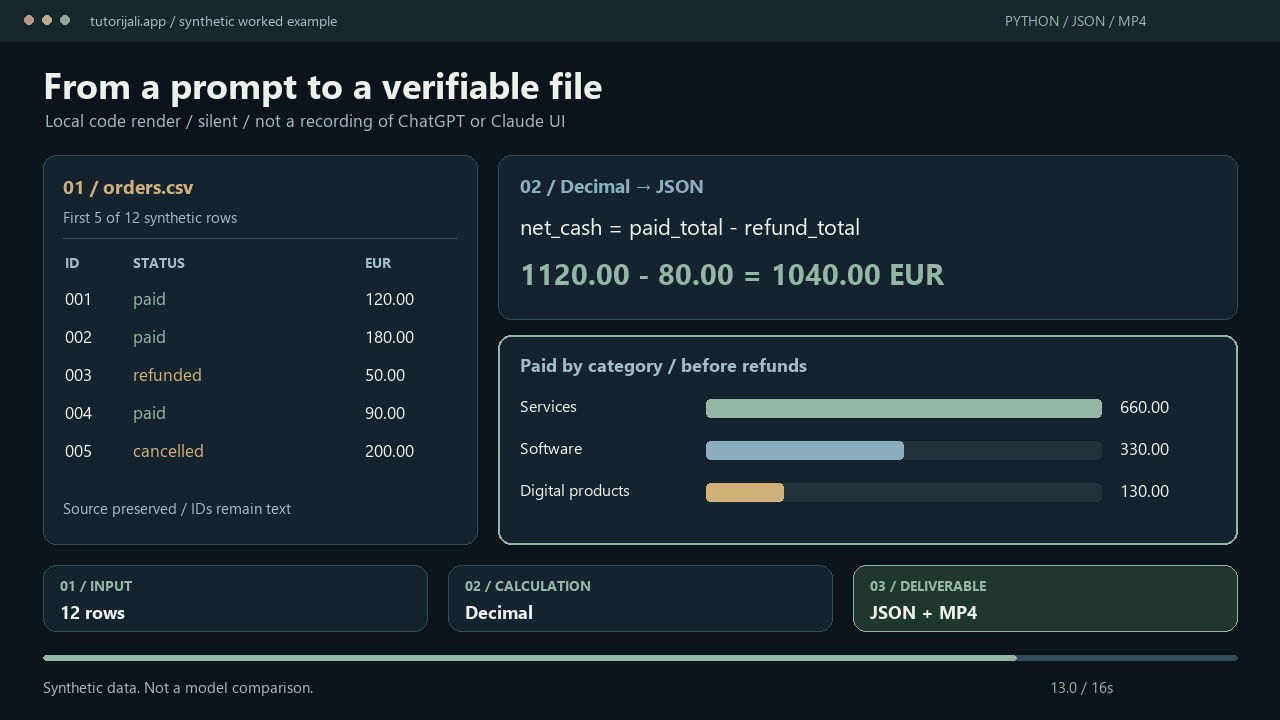
Paid category totals are EUR 660.00 for services, EUR 330.00 for software and EUR 130.00 for digital products. They sum to EUR 1,120.00 before refunds. This deliberately narrow example is not an accounting, tax or revenue-recognition system.
The supplied evidence contains 14 successful checks: six fixture assertions and eight rejection cases covering duplicate IDs, unknown status, a different currency, an impossible date, NaN, excess decimals, an empty category and an empty dataset. Those are preserved as supplied results; the publication run recalculated the analysis, rather than relabeling those checks as newly executed tests. Large-file performance and linked partial-refund events remain outside scope.
Example C: a real, silent MP4 from the JSON
The original package contains an eight-second 1280 × 720, 24 FPS animation and its reported verification. The publication adds a more detailed 16-second English/Serbian version with a visible input table, calculation stages, category bars and final output. Its net amount comes from publication-analysis.json, not a manually substituted display number.
Create a silent 16-second, 1280x720 animation at 24 FPS showing synthetic
CSV input, Decimal calculation and JSON output. Read values from the actual
analysis JSON. Keep the input, arithmetic and scope readable. Save source,
MP4 H.264/yuv420p, poster and descriptive captions. Identify it as a programmatic
render, not recorded ChatGPT/Claude UI or generative video output.
The published renderer uses Pillow and FFmpeg. The downloadable manifest records actual versions, dimensions, duration, decoded-frame count and decoding outcome for the new media. Original and publication reports have different paths. No comparison with Claude, real business performance or access to a photorealistic video generator is inferred from this artifact.
Downloads and evidence
- Open the searchable prompt explorer.
- Download bilingual sources, prompts and publication reports.
- Inspect the recalculated analysis.
- Inspect the publication media manifest.
- Download the original Serbian research package.
Reproduction needs compatible Python, Pillow, FFmpeg with libx264 and an installed font. The supplied original renderer uses Linux font paths; the new renderer supports Windows and Linux candidates. The original package's reported versions differ from this publication's environment. Install dependencies into an isolated environment where appropriate. Scripts operate on local synthetic data; the explorer does not call a model API or send entered search text to a remote service.
Connect categories into complete jobs
A useful end-to-end task often spans several categories. Preserve artifacts and evidence between phases rather than combining unrelated requests without dependencies.
Path 1: idea to a small public application
Combine specification (11), implementation (12), access (17), validation (15) and release (20). Add VPS (01), proxy (03) and backups (06) for your own server. Start with one complete journey and expand after it works.
Carry this project through to an app supporting [one journey]. Work through
specification, implementation, validation and release preparation. Save a
concrete artifact and update open questions at each phase. Follow the existing
project for routine decisions. Do not claim public deployment until the actual
deployment and journey have been checked.
Path 2: messy documents to a business report
Combine extraction (25), cleaning (21), analysis (22), charts (24) and a report (27). Keep page/row references. Automate recurring transformations rather than repeating manual corrections. Original documents remain authoritative when outputs disagree.
Create a report answering [question] from these documents. Preserve every
record's source, flag unreadable values, compute metrics with code and reconcile
totals. Deliver an editable table, report and repeatable next-period procedure.
Limit conclusions to the data actually processed.
Path 3: technical article to a short explainer
Combine research (29), writing (31), imagery (41), animation (47), narration (49) and subtitles (50). A short video should communicate one message and link to the evidence. Values and captions should use the same source as the article.
Turn the finished article into a short explainer about [message]. Preserve
verified claims and state what is omitted for length. Prepare scenes, narration
and subtitles. Produce media only through available tools. Deliver sources,
the video and an account of unverified parts.
Path 4: repeated manual work to automation
Combine source research, import (30), integration (59), reporting and scheduling (58). Complete one sample run first. Define retries, duplicate handling and how to distinguish no new data from an unavailable source.
Automate [steps] over [sources]. First deliver one sample run and inspectable
outputs. Add duplicate prevention, failure records and checkpoints. If scheduling
is requested and supported, save the agreed cadence. Explain how to stop the
workflow and resume after failure.
Judge the result by its evidence
| Question | Useful evidence | Insufficient evidence |
|---|---|---|
| Is the server configured? | Service, port and expected response on the named target | Generated configuration without application |
| Is the app fixed? | The original scenario now succeeds | A successful build alone |
| Is the calculation correct? | Code, definitions, totals and source rows | Persuasive prose containing numbers |
| Was the document created? | A file that opens with an inspected layout | Text without the requested file |
| Was the video created? | A file with checked image/time properties | A screenplay or future-tense description |
| Was the message sent? | Service confirmation for the authorized task | A draft labeled as a sent message |
| Was the task scheduled? | A saved schedule and reviewed execution | A promise in conversation |
This guide does not establish a universal winner across 60 categories. Such a claim would require defined model versions, identical materials and scored comparative trials. Start with tools, data access, formats and performance on your own representative task.
For a comparison, choose five to ten jobs you actually repeat. Preserve identical inputs and criteria; record model, interface, date and enabled tools. Evaluate functionality, correctness, corrections and documented cost. Treat different tool access as an environment difference rather than automatically a model-quality difference.
Questions that change the outcome
Can one prompt cover the whole job? Yes, it can define the goal, but larger jobs still need phases and checkpoints. One prompt does not remove dependencies.
Do I need programming knowledge? Many writing and document tasks do not require it. Production software still needs someone able to inspect results, verify behavior and recover. Ask for explanations and start in a trial environment.
Why does code work in the chat but not locally? Operating systems, versions, permissions, networks, fonts and packages can differ. Request exact prerequisites and commands, with the execution environment distinguished from the deployment target.
Does a subscription include every API or connected service? Check the specific plan and authentication. An interface feature, developer API and third-party paid service are separate things. Generated integration code does not prove an active account or budget.
What if an answer looks right but is difficult to verify? Ask for source material, formulas, document locations, command output and a small control example. Without evidence, keep the conclusion labeled as a proposal or assumption.
What if a document contains instructions for the AI? Treat the document as task data. Its words do not independently authorize changing goals, sending data or running commands. This matters especially with connected services and third-party documents.
Practical capability comes from combining a defined task, useful data, available tools and appropriate review. Apply the same questions to all 60 categories: what outcome was requested, which prerequisites were met and what evidence demonstrates completion?
Primary sources and review date
The feature-sensitive claims were reviewed against official documentation on November 18, 2026. The category prompts are editorial workflows, not an official product catalog. The original laboratory evidence and the publication's new renders are identified separately in the downloads.
- Use ChatGPT
- Claude tool use
- Claude Code
- Video generation and retirement notice
- Claude Motion
- Google video generation
- Code generation
- Work with files
- Claude code execution
- Claude Artifacts
- Web search
- Plugins
- Claude connectors
- Image generation
- Claude vision
- Text to speech
- Browser
- Scheduled tasks
- Claude scheduled tasks
For future revisions, recheck plan/region availability, interface names, video-model status, export formats and automation prerequisites. No automatic revision has been scheduled.
Self-hosted email in 2026: control, costs and a real outage experiment
Does your email keep working when the primary server fails? Domains, software, networking, costs and recovery, with real Postfix/Dovecot trials, raw observations and a separate 24-hour model.
JPEG XL and AV2 in 2026: a practical guide to image and video compression
How JPEG XL and AV2 work, what browsers support and what the supplied files actually show. A detailed guide with an interactive desk, commands and sources.

What can apps really see in your phone’s photo library? Android, iPhone and privacy
One photo or the entire library? An in-depth investigation of permissions, MediaStore, PhotoKit, EXIF and upload evidence, with an interactive explainer and source for a native experiment.
Email API services in 2026: prices, free plans and the limits that matter
Prices and real quota distinctions for 20 transactional email services. Explore modeled costs, burst capacity, implementation examples and a reliable sending workflow.
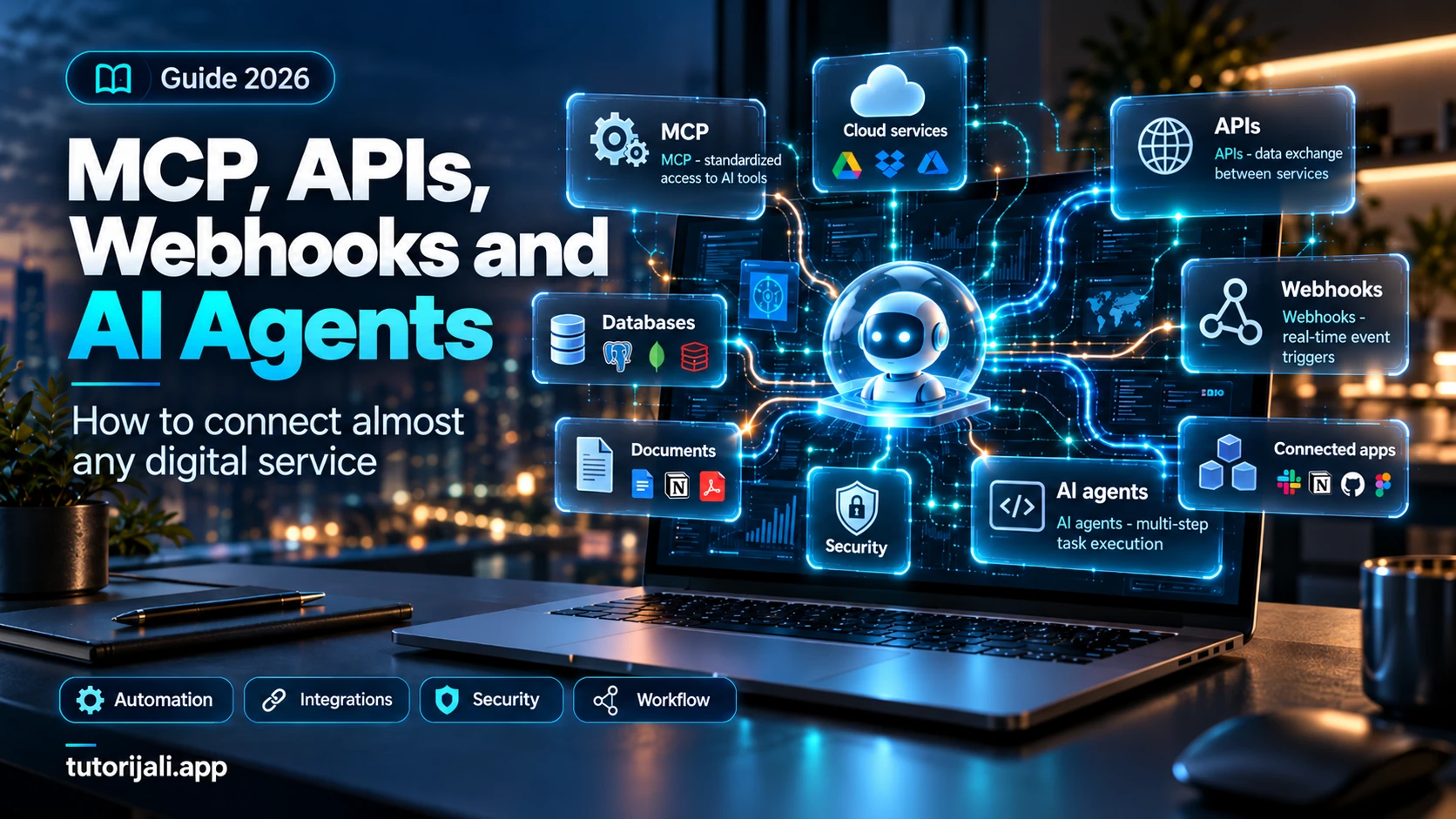
MCP, APIs, Webhooks and AI Agents: How to Connect Almost Any Digital Service in 2026
A complete practical guide to MCP, APIs, webhooks, and AI agents: compare the technologies, build n8n workflows and a Python MCP server, receive webhooks securely, explore 25 integration ideas, and review a production checklist.

How to Find Clients and Build a Premium AI Website Demo in 20 Minutes: Claude Opus 5.5, 3D, and 15 Prompts
A practical guide to researching local businesses, building an AI-assisted website demo, and using 15 prompts for different industries.
Share your thoughts, questions, or tips about this article.