One photo or the entire library? An in-depth investigation of permissions, MediaStore, PhotoKit, EXIF and upload evidence, with an interactive explainer and source for a native experiment.
You give an app permission to attach a photo. Does that mean it can browse your entire camera roll? Could it read dates and file sizes without opening every image? Does selecting one picture prevent the app from uploading that picture later?
The answers depend on the access model. A broad library permission, an Android Photo Picker result, and an iPhone limited Photos library are different technical boundaries. The operation an app actually performs is another question. Network transfer requires its own evidence.
The central distinction: permission to read, an observed read, and a documented upload are three different claims. Each needs a different kind of proof.
This guide examines Android MediaStore, Photo Picker, iPhone PhotosPicker and PhotoKit, EXIF metadata, cloud providers, and a reproducible native experiment using twenty synthetic images. It also explains the November 2026 Italian regulatory action concerning Facebook camera-roll suggestions.
Explore the companion: Open the interactive access explainer, download the native source and synthetic dataset, or inspect the dataset manifest.
Evidence status, November 16, 2026: the regulatory release and platform documentation were checked. The Android projects and SwiftUI sample are supplied as source, with a protocol and empty result template. No native build, device benchmark, Facebook instrumentation, measured photo count or mobile latency is claimed. The browser companion is explicitly an educational simulation over supplied test files.
At a glance
Italy's Garante announced an €805 million fine against Meta Platforms Ireland Limited on November 14, 2026. Its findings concerned Facebook's Android camera-roll suggestions feature, available since 2023, a broad permission shared across features, insufficiently specific explanations, and a suggestion function enabled by default. The authority estimated roughly 20 million relevant Android users in Italy. 1
This does not establish that every unpublished image was uploaded. The authority explained that its terminal-access consent requirement applies independently of transmission or demonstrated harm. It also stated that possible AI training was outside this proceeding, with a newer cloud-processing feature reserved for separate examination. Meta disputes the findings and penalty and announced an appeal, according to ANSA. 1
What this guide helps you do
- Distinguish broad library access from a user-selected item.
- Understand Android 14 Selected Photos Access without confusing it with Photo Picker.
- Separate MediaStore index fields, EXIF tags, and information visible in the image.
- Understand iPhone PhotosPicker and full or limited PhotoKit authorization.
- Run a controlled native experiment without personal photographs.
- Ask what evidence supports a claim about reading, uploading, or AI processing.
- Review your current permissions and design apps around the narrowest useful access.
The timeline and the actual regulatory findings
2023: Facebook introduced the camera-roll suggestions feature discussed in the authority's release. It suggests locally available photos and videos as potential posts while someone browses Facebook. 1
July 2025: the investigation began following a complaint from the consumer-protection center in Bolzano. The authority says it also performed a technical analysis. 1
November 14, 2026: Garante announced the fine. It identified a single app-wide permission covering different purposes, a generic explanation, and default activation of suggestions. It cited the affected population, duration, an earlier 2019 proceeding, and limited cooperation. The release describes the penalty as approximately 0.47% of the group's worldwide turnover. 1
Remedial deadlines: the release requires a separate, specific consent request, clear explanations and instructions, and default deactivation within 60 days. It also sets 30- and 90-day reporting deadlines. These are the authority's published requirements, not a prediction about the outcome of an appeal. 1
Meta's position: the company says the feature requires an operating system permission that users can change, disputes the regulator's assessment, considers the sanction disproportionate, and plans to challenge it. ANSA is used here to attribute that response, not as a substitute for platform documentation. 2
What the announcement establishes
| Claim | Status in the published material |
|---|---|
| Garante imposed an €805 million penalty | Confirmed in the authority's release |
| Android camera-roll suggestions were the subject | Confirmed |
| One permission covered multiple purposes | The regulator's finding |
| Suggestions were enabled by default | The regulator's finding |
| Every private image was uploaded | Not established by this announcement |
| Those images trained AI models | Outside this proceeding |
| Users never granted any OS permission | Not the same claim; Meta emphasizes the OS permission |
| Every Android device and Facebook release behaves identically | Not supported |
Why the legal basis matters
The announcement identifies Article 122 of Italy's Privacy Code, implementing the relevant ePrivacy rules. It distinguishes access to information on terminal equipment from subsequent processing or transmission. It also explains why the authority rejected Meta's jurisdiction objection based on the Irish authority and the one-stop-shop mechanism. 1
Calling this simply a generic GDPR fine loses that distinction. GDPR principles can remain relevant to personal data, but a report should state the basis of this particular action accurately. Other jurisdictions, later decisions and appeals require their own sources.
Permission, reading and sending are separate events
An app with broad photo access does not necessarily open every file immediately. It may query an index, open one chosen object, produce a local thumbnail, run classification on the device, or perform no operation until the user asks.
Transmission is another step. An app might send original bytes, a transformed image, a thumbnail, extracted text, a category, or a derived identifier. Alternatively, it might keep all processing local. A permission screen alone cannot tell you which happened.
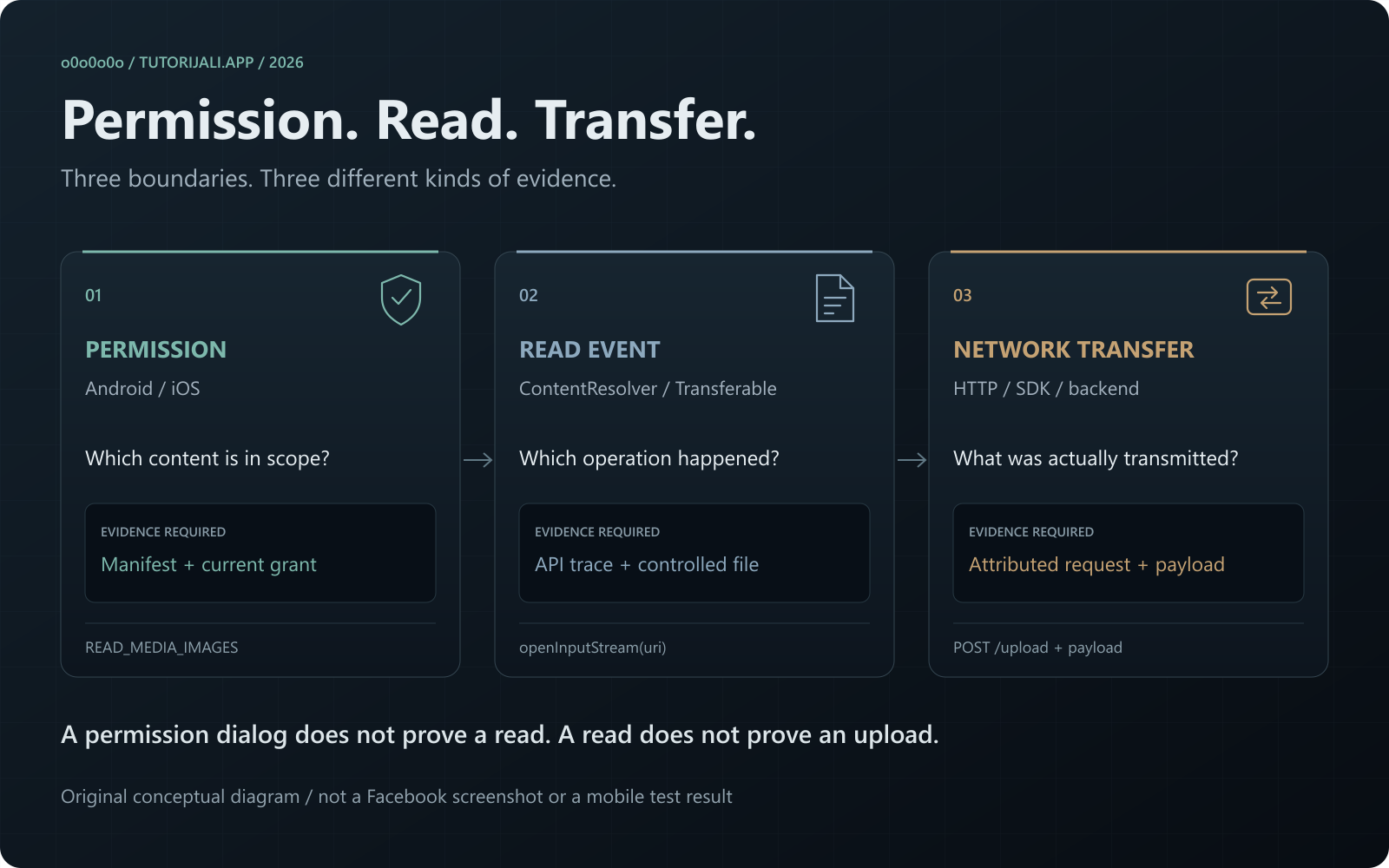
| Layer | What evidence can establish | What it does not establish alone |
|---|---|---|
| Declared permission | What the manifest requests | That the user granted it |
| Current authorization | What the OS currently permits | That every available photo was read |
| Index query | Which rows the provider returned | That every corresponding file was opened |
| Successful stream operation | That specific content was read in that test | That it was uploaded |
| Attributed network payload | A particular transfer under documented conditions | All past or future behavior |
An unsuccessful observation also has limits. Not seeing an upload during a short test means only that the instruments did not observe that transfer in those conditions. It does not prove the app never transmits anything.
How Android stores and exposes photographs
Files, index entries and URIs
A photograph might be a local JPEG, a HEIC original, a downloaded representation, or content exposed through a cloud provider. Treating everything as a directly readable path under DCIM is an outdated model.
MediaStore indexes shared media and exposes structured queries and content:// URIs. ContentResolver performs the query or opens the content through the provider, subject to current access rights. A URI is an address within that system, not a universal promise of permanent access. 3
Photo Picker is a separate system-mediated selection route. It lets the user return chosen media to an app without necessarily granting broad library permission. Other apps' private directories are not simply included in ordinary shared-media access. 4
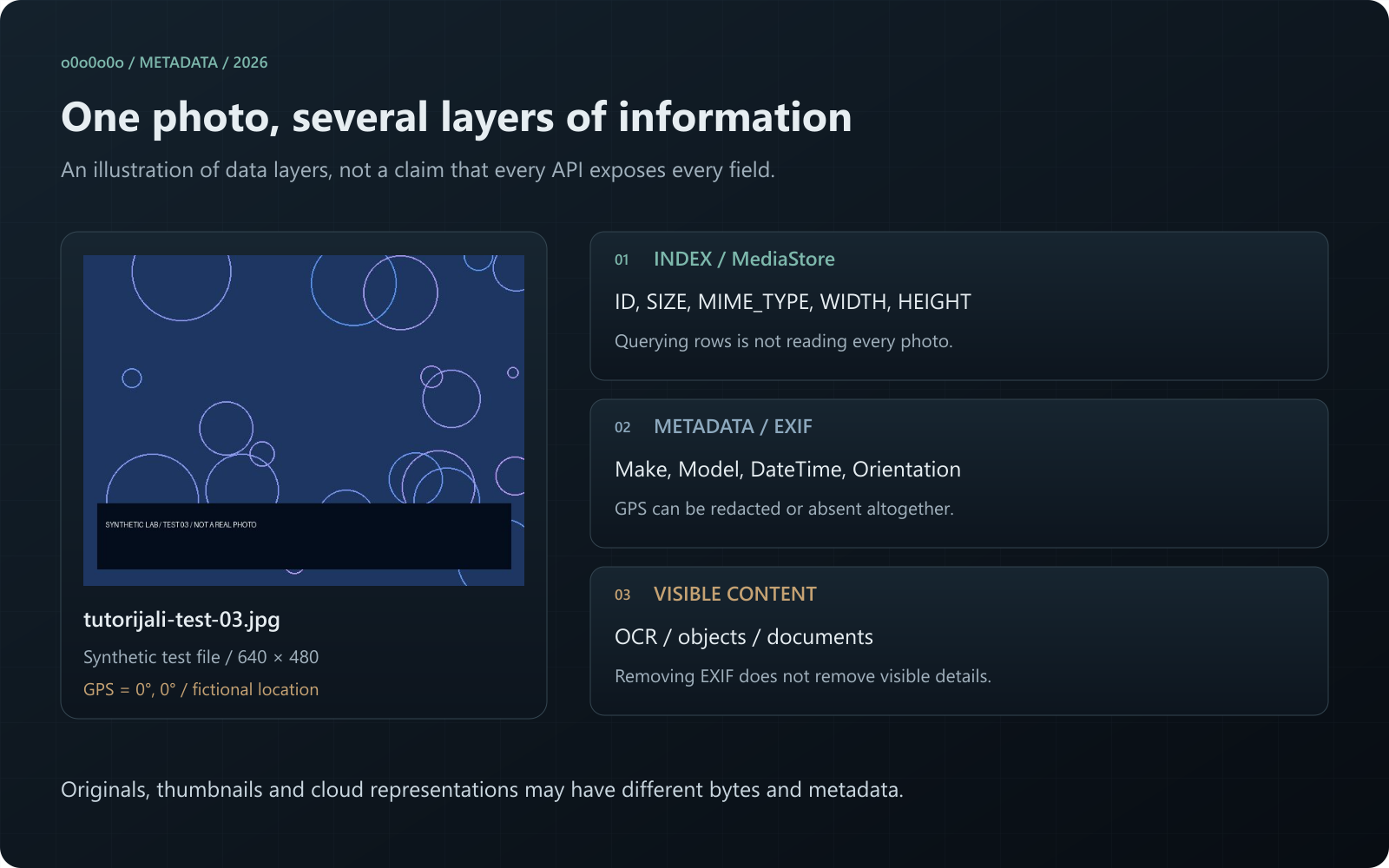
Available index columns can include record ID, MIME type, size, dimensions and dates. Values and provider behavior vary by Android version, manufacturer, source and representation. Location-bearing metadata can have additional protections.
Scoped storage and old tutorials
Android's scoped-storage model evolved from Android 10. Later behavior depends on both the OS and the app's target SDK. Android 13 introduced granular image and video permissions; Android 14 added user-selected partial access within the media-permission model. 37
READ_EXTERNAL_STORAGE is not a universal modern answer. MANAGE_EXTERNAL_STORAGE is also not an appropriate replacement for an app that merely needs a profile picture: all-files access has a separate restricted purpose and policy. 5
Broad access is not the entire phone
A broad image permission concerns the media objects available through the granted scope. It does not guarantee access to private app directories, encrypted databases, every Downloads file, other user profiles, secure folders, or unsynchronized cloud originals. The correct question is which provider, collection and current grant are involved.
Android's permission map
| Platform | Relevant model | Practical meaning |
|---|---|---|
| Android 10-12L, API 29-32 | Scoped storage and relevant legacy shared-media permissions | Prefer a system picker or document route where suitable |
| Android 13, API 33 | READ_MEDIA_IMAGES and READ_MEDIA_VIDEO | Images and videos have separate broad permissions |
| Android 14+, API 34+ | Selected Photos Access, target-SDK and compatibility rules | Some permission flows offer full, selected or denied access |
| iOS 14+ | Limited PhotoKit library and a separate system picker | Limited library authorization and individual selection differ |
This is a map of mechanisms, not a promise that every device displays the same dialog. Record target SDK, current grants, picker availability, system-component versions, manufacturer and OS. Android documents compatibility behavior and optional adaptation details beyond a single OS-version label. 6
Broad image permission
An app with effective full image access can query available MediaStore image records. In a clean test collection that might mean all twenty synthetic files, but that is a hypothesis to measure, not a result to enter in advance.
<uses-permission android:name="android.permission.READ_MEDIA_IMAGES" />
A manifest declaration is not a runtime grant. Ask when the feature needs access, handle denial and revocation, and comply with the separate distribution policy. 5
Selected Photos Access
An app maintaining its own media browser can adapt to Android's partial-access model using the appropriate permissions and reselection flow. 6
<uses-permission android:name="android.permission.READ_MEDIA_IMAGES" />
<uses-permission android:name="android.permission.READ_MEDIA_VISUAL_USER_SELECTED" />
Our native lab uses the logical report labels full-images, selected-images and denied. They are lab labels, not platform constants. The real check uses current permission state and API-version rules.
Do not permanently cache a successful check. A user can change the authorized set while the app is in the background. Recheck appropriately on return and refresh the query.
Compatibility mode and lifecycle
Google describes compatibility behavior for apps that have not adapted to Selected Photos Access. Some selected grants are temporary and can be lost after leaving the app or stopping its process. That is distinct from assuming a durable selected-library permission. 6
An old URI can therefore fail later. Handle missing or revoked access as an expected condition, explain how to select again, and avoid treating a stale permission check as an invariant.
System Photo Picker
For an occasional attachment, the picker usually provides the narrower route. A single-selection contract returns a chosen item or a cancellation result, without asking for broad media permissions. 4
private val pickImage = registerForActivityResult(
    ActivityResultContracts.PickVisualMedia()
) { uri ->
    if (uri != null) {
        contentResolver.openInputStream(uri)?.use { stream ->
            // Process only the user-selected content.
        }
    }
}

pickImage.launch(
    PickVisualMediaRequest(ActivityResultContracts.PickVisualMedia.ImageOnly)
)
The returned URI does not grant a list of every photograph. However, the app can process the selected content, potentially save a copy, or upload it as part of a feature. Narrowing scope does not make the chosen photo anonymous or prevent all downstream uses.
AndroidX can fall back to ACTION_OPEN_DOCUMENT when the picker is unavailable. Record the actual route rather than assuming every supported device used the same implementation. 4
How long does a chosen URI remain usable?
Picker grants are not necessarily limited to the instant of selection. Android documents grant lifetimes and persistence for longer tasks through takePersistableUriPermission() where appropriate. Grant limits and validity conditions also apply. 4
Revoking the original grant does not automatically delete a copy already made inside the app or on a server. Access to the original, retained copies and server retention are separate controls.
Google Play policy adds a distribution boundary
Technical capability is not permission to publish any access pattern. Google Play restricts broad photo and video permissions to justified core functionality when a picker is insufficient. Developers retaining those permissions may need a declaration and review. 5
A profile avatar, one fault-report attachment or a single message image rarely needs a whole library. A gallery organizer, backup product or batch editor can have a different core need, but still needs a proportionate design and clear explanation.
Installing an experimental APK privately does not establish that it meets Play distribution requirements. The supplied apps are educational lab sources, not a claim of store approval. Consult the current policy and effective dates when preparing a release.
What an index query may reveal
An app can learn useful information from available index records without decoding every image.
| Data | Example | Possible significance | Important limit |
|---|---|---|---|
DISPLAY_NAME | IMG_2042.jpg | Naming and organization patterns | Does not establish visible image content |
SIZE | 4,283,120 bytes | File-size distribution | Can be unknown or representation-dependent |
MIME_TYPE | image/jpeg | Format | Not the image itself |
WIDTH, HEIGHT | 4032 × 3024 | Resolution and aspect ratio | Not a reliable phone-model identification |
| Dates | Capture or modification time | Activity patterns | An index date is not necessarily EXIF DateTimeOriginal |
| URI or media ID | content://media/... | A provider record | Not a permanent global identifier |
| Opened bytes | JPEG content | Objects, faces, documents, OCR | Requires an actual content-read operation |
| EXIF | Model, software, orientation | Technical context | Depends on file and transformations |
| GPS EXIF | Latitude and longitude | Capture location | Can be absent, redacted or separately protected |
Once an image is read, visual inference adds another layer: a receipt, street sign, document, account screen, license plate or recognizable building may reveal information absent from EXIF. That is content analysis, not metadata extraction.
The regulator's release mentions photos, videos and metadata, but does not publish an exhaustive per-version EXIF field list. It does not justify asserting that Facebook read every GPS tag from every image. Distinguish a possible data type, a measured availability and a documented company action. 1
EXIF, location and representation changes
EXIF can contain camera make and model, software, exposure, ISO, orientation, dates and location. Not every format or file contains it, and apps differ in what they preserve.
GPS needs special treatment
Under Android's scoped-storage model, location metadata may be redacted. Obtaining unredacted location in the relevant circumstances requires ACCESS_MEDIA_LOCATION, the user's grant, and the appropriate original-media access route such as MediaStore.setRequireOriginal() where supported. Do not assume the location permission was granted or that every provider supports the same operation. 3
The supplied apps do not request ACCESS_MEDIA_LOCATION, display coordinates, or attempt to bypass redaction. Every third synthetic source JPEG contains a fictional GPS tag at 0°, 0°. That is test data in the file, not an observation that Android or iOS exposed it to an app.
A photo is not always returned as identical bytes
A cloud download, HEIC conversion, thumbnail, screenshot or sharing pipeline can change dimensions, compression and metadata. The delivered representation may differ from the original.
Test the exact route before claiming that sharing always removes or preserves location. A provider fetching a cloud object is also a different network event from an investigated app uploading personal data.
Removing EXIF is not complete anonymization
The frame can still contain a face, address, document, account, location clue or other sensitive detail. Metadata review and visual review solve different parts of the privacy problem.
iPhone: PhotosPicker and PhotoKit are different routes
Apple separates system-mediated photo selection from direct library authorization. PhotosPicker and PHPickerViewController can provide chosen items without broad PhotoKit authorization. The app then explicitly loads a representation through Transferable or the relevant provider mechanism. 817
A narrow SwiftUI selection
import SwiftUI
import PhotosUI

struct DemoView: View {
    @State private var item: PhotosPickerItem?

    var body: some View {
        PhotosPicker(selection: $item, matching: .images) {
            Text("Choose one photo")
        }
    }
}
The downloadable SwiftUI sample also loads the chosen item. A cloud-backed photo may need downloading, and a requested representation may be unavailable. Selection, successful loading and original-file identity should not be conflated. 9
Full and limited PhotoKit authorization
An app genuinely managing a library can request read/write PhotoKit authorization and handle the result:
PHPhotoLibrary.requestAuthorization(for: .readWrite) { status in
    switch status {
    case .authorized: print("Full access granted")
    case .limited: print("Access to selected photos")
    case .denied, .restricted: print("No access")
    default: break
    }
}
This route needs an appropriate NSPhotoLibraryUsageDescription in the Xcode project's Info.plist. Choose the narrowest useful model and accommodate the authorized subset. 8
Limited does not mean no downstream risk
A limited grant restricts the library subset exposed through that authorization. For the allowed photos, still consider the content, cache, copies, cloud processing and uploads.
PHAsset and a MediaStore row are not interchangeable implementations. Compare the user's control over scope, while documenting platform-specific objects, representations and lifetimes.
Cloud libraries add another actor
An image visible in a gallery is not necessarily an original already stored locally. Eligible Android cloud media providers and iCloud Photos can supply content through system-mediated routes. 4
Keep four questions separate:
- Is the item represented in the library or index?
- Does this app receive a usable URI or object?
- Are the bytes local, or must someone download a representation?
- Which process owns any resulting request?
The system provider may use its own network privilege. Observing device traffic while a picker resolves an item does not establish an upload by the lab app. The baseline experiment therefore uses only twenty local synthetic JPEGs with cloud synchronization disabled.
A normal MediaStore read sequence
An app first queries the provider:
val projection = arrayOf(
    MediaStore.Images.Media._ID,
    MediaStore.Images.Media.SIZE,
    MediaStore.Images.Media.MIME_TYPE
)

contentResolver.query(
    MediaStore.Images.Media.EXTERNAL_CONTENT_URI,
    projection, null, null, null
)?.use { cursor ->
    // Inspect returned records within the current grant.
}
A successful query establishes returned records in that configuration, not reads of all their corresponding contents.
The broad-access sample separately opens the first available item's stream and samples at most 256 prefix bytes. It then reopens the same item for EXIF parsing. The EXIF parser may read additional bytes: the prefix counter is not a total-I/O counter for the entire operation.
The report records aggregate rows, known sizes and whether benign camera/date tags were present. The picker app follows the URI chosen by the user rather than querying the whole collection. An unavailable provider, stream failure or partial query must be reported as an error, not silently converted into a successful measurement.
What changes when an app goes into the background?
Three states matter:
- Access rights: whether a library permission or URI grant remains valid.
- Execution rights: whether the OS permits this process or scheduled work to run.
- Retained copies: data already copied into an app's own storage or another service.
Library permission does not grant unlimited background execution. Closing an app also does not universally revoke every grant or delete every copy.
Test foreground, background, return, process stop, device restart and manual revocation separately. Android compatibility-mode grants and iOS picker results have different lifetimes. Avoid universal statements about what all apps do after being closed. 6
What permissions cannot tell us about Facebook
The lab is not Facebook's source code, and the authority's release is not an exhaustive runtime trace of every analyzed version. We cannot reconstruct all internal processing from it.
The available evidence does not establish that every image was uploaded, that every image trained AI, or that each user's installation currently uses an identical feature. Equally, lack of a broad media permission does not prevent an app receiving an explicitly selected item.
The purpose is to understand controlled OS boundaries and evidence standards. It is not to infer developer intent from a permission count or describe our source apps as measurements of Meta's production software.
The native lab: two Android apps, one controlled collection
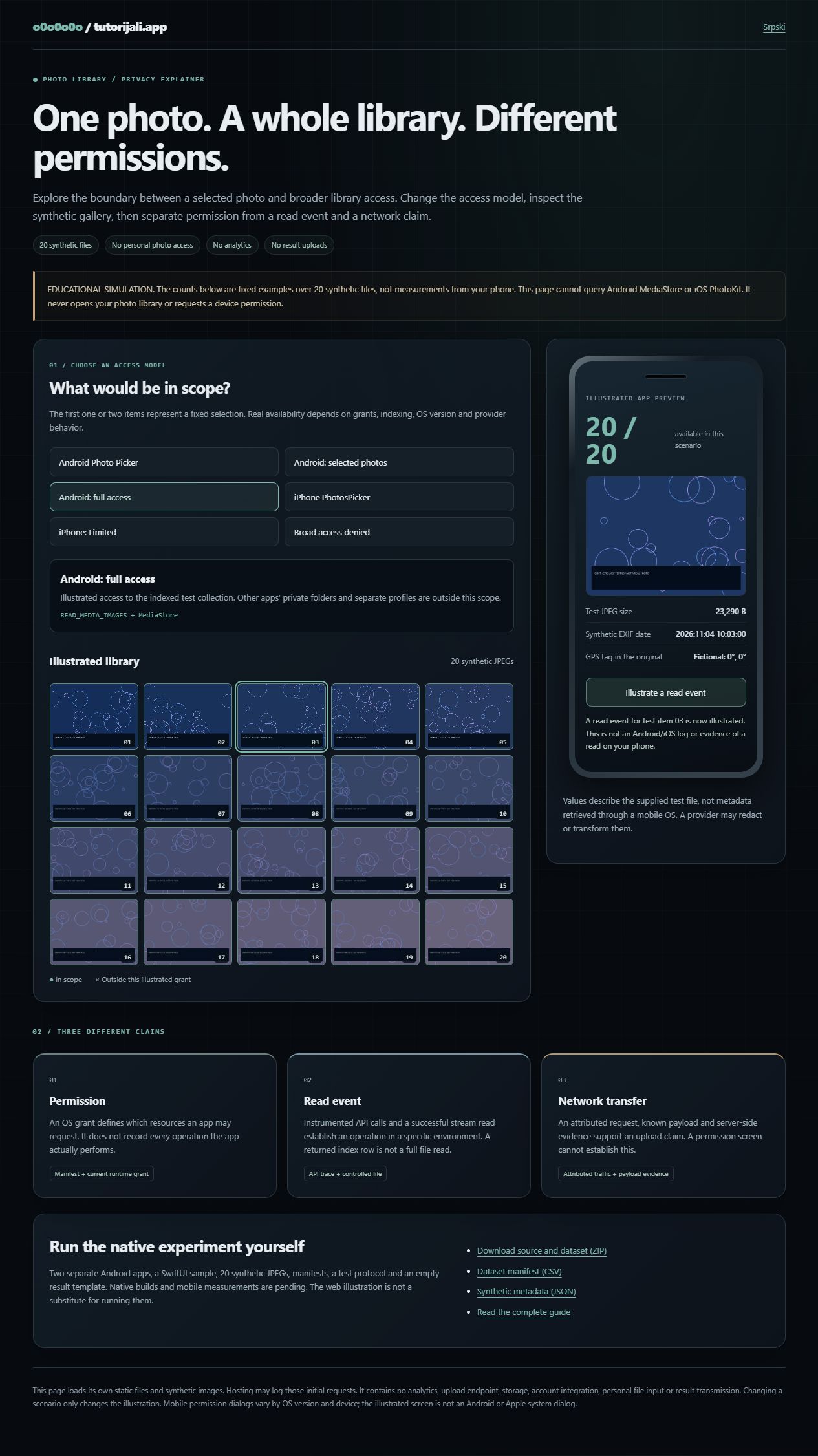
Download the native source package. It contains separate Android packages, an iOS source example, a protocol, synthetic data and an empty report template. The browser access explainer visualizes the concepts but cannot run MediaStore or PhotoKit.
Why separate Android packages?
The manifest contributes to each app's permission boundary. Keeping broad-access and picker-only examples separate makes their declared scopes inspectable and avoids confusing an existing broad grant with the permission requirements of a picker feature.
App A: broad and selected MediaStore access
app.tutorijalilab.broad declares READ_MEDIA_IMAGES and, where relevant, READ_MEDIA_VISUAL_USER_SELECTED. It retains an appropriately capped legacy storage declaration for supported older devices. It does not request video access because the baseline contains images only.
The user explicitly requests authorization, triggers a query and sample read, then exports a JSON report through the system document dialog. It does not automatically scan on first launch.
The manifest omits INTERNET and ACCESS_MEDIA_LOCATION. There is no advertising SDK, analytics, account integration or upload feature in the supplied source. Inspect the built APK's merged manifest if you build it; source inspection is not a substitute for checking a distributed artifact.
App B: a single picker result
app.tutorijalilab.picker declares no broad image, video or legacy storage permission and no location or internet permission. It launches Photo Picker, accepts the chosen result, samples a prefix, checks benign EXIF tag presence, and offers a local report export.
Canceling selection should produce no new read report. A canceled selection is a negative control, not evidence of a successful one-photo read. Clear or distinguish older reports before exporting results for a new trial.
What omitting INTERNET does and does not establish
It removes ordinary direct networking privilege from these Android app processes. It does not make the entire phone offline. Providers, OS components and other apps have their own privileges.
Use a clean local collection to reduce those variables, attribute traffic to its owner, and describe the work as a local permission experiment rather than a comprehensive phone audit.
Native results are still pending
The sources have not been presented as compiled APKs or executed iOS experiments. No measured row count, native screenshot, latency distribution, store certification or Facebook behavior result is supplied. Keep that distinction when reproducing or sharing the material.
Twenty synthetic images, no personal gallery
The test collection uses 640 × 480 JPEGs containing geometric patterns and visible synthetic-lab labels. The files are intentionally artificial: access boundaries do not require exposing faces, documents, health information or home coordinates.
Each file has Make=Tutorijali LAB (synthetic), a fictional camera model and a synthetic date. Every third file contains fictional GPS at 0°, 0°. The accompanying CSV manifest and JSON metadata document the supplied source files.
These are file properties, not claims about metadata delivered through a mobile provider. A device may redact location or transform the representation.
The Pillow generator uses controlled patterns and a fixed seed. Exact bytes can still differ between library versions; retain final SHA-256 values and tool versions for strict reproduction.
python -m pip install Pillow
python tools/generate_test_images.py

adb devices
adb shell mkdir -p /sdcard/DCIM/TutorijaliLab
adb push dataset/synthetic-gallery/*.jpg /sdcard/DCIM/TutorijaliLab/
The wildcard example assumes a shell that expands it as intended. If your shell or adb version does not, transfer the JPEGs individually or through the emulator's file tools. Verify indexing in the system gallery before measuring MediaStore rows. Copying a file does not prove immediate provider indexing.
Control the environment
- Use a clean emulator or dedicated device without a personal library.
- Disable cloud synchronization for the baseline.
- Record OS, API level, security patch, target SDK and picker/provider versions.
- Keep the same collection and restore a known snapshot between relevant trials.
- Treat work profiles, secure folders and manufacturer-specific private spaces as separate experiments.
- Retain aggregate results and inspect error text before sharing reports.
The experiment matrix
The template contains ten baseline cases, with additional lifecycle variations. Expected access is a hypothesis, not a prefilled result.
| Case | Platform | Access or action | Record |
|---|---|---|---|
| A-01 | Android 13 | Full images | Available rows, known size sum, duration, errors |
| A-02 | Android 14+ | Full images | Same measurements under the newer model |
| A-03 | Android 14+ | Select exactly two | Returned scope and lifecycle changes |
| A-04 | Android 14+ | Deny | Behavior without the broad grant |
| B-01 | Android 13+ | Pick one | Chosen URI operation and representation |
| B-02 | Android 13+ | Cancel picker | No newly selected item or read |
| B-03 | Android 13+ | Pick, then restart | Grant lifetime where specifically instrumented |
| iOS-01 | iOS 16+ | PhotosPicker | One selected representation loaded |
| iOS-02 | iOS 16+ | PhotoKit Limited, two | Available PHAsset objects |
| iOS-03 | iOS 16+ | PhotoKit Full | Available test-library PHAsset objects |
Full access: verify the denominator first
Confirm the twenty synthetic images are indexed. If an extra factory image appears, twenty-one returned rows does not mean 105% exposure. Isolate the collection or separately identify the controlled set before calculating a ratio.
Partial access: record the event order
For a two-image selected grant, record T0 authorization, T1 foreground query, T2 background, T3 return, T4 manual reselection and T5 another query. Recheck state after transitions instead of trusting the first successful permission check.
Picker-only access
Confirm the app did not request broad media access and record the selected operation. Distinguish cancellation from a failed load. Separate cloud-backed results from the local baseline.
This route does not prove the app knows nothing else: it may have earlier grants, its own files or retained copies. The conclusion concerns the declared and tested access model.
iOS cases
Import the synthetic collection, add the SwiftUI source to an Xcode project, and test PhotosPicker separately from limited and full PhotoKit authorization. Record the loaded representation's byte count, not an assumed original iCloud file size. The supplied source is a standalone file, not a ready-to-run Xcode project.
Lifecycle sequence
For each relevant grant, open a test item, background the app, return, stop its process, reopen it, restart the device, revoke access in Settings, and repeat only when valid authorization exists. Retained-copy experiments belong in a separate category because the baseline source intentionally avoids saving a photo copy.
Define the metrics before collecting numbers
Use explicit definitions:
U: controlled synthetic objects successfully imported and indexed.A: available objects returned by the relevant MediaStore query.S: items explicitly chosen in the picker trial.P_declared: permissions in the manifest.P_granted: current authorization.P_effective: objects and operations actually available.P_used: content operations actually performed.N_observed: network events observed by the instruments.
Illustrated exposure ratio for a controlled MediaStore set:
E = 100 × A / U
This ratio is meaningful only when A and U describe the same controlled set. For picker selection, S/U describes a different quantity and should not be labeled an identical MediaStore measurement.
Broad authorization can coexist with reading only one item. A one-photo grant can coexist with extensive analysis of that photo. Neither count substitutes for investigating processing.
Timing
Repeat operations under documented conditions and report distributions, medians and ranges. Record warm/cold cache, device, API level, file count, network state, battery and indexing activity.
The broad sample's timer covers the query and sample/EXIF work, not a pure database query benchmark. SystemClock.elapsedRealtimeNanos() measures local elapsed time; it does not establish GPU acceleration, storage-driver efficiency or network performance.
Reports without photographs
The following is a schema illustration, not a result:
{
  "app": "broadapp",
  "android_api": 35,
  "permission_scope": "selected-images",
  "accessible_media_rows": null,
  "media_size_bytes_sum": null,
  "sample_exif_camera_tag_present": null,
  "network_permission_declared": false,
  "error": "NOT_RUN - illustrative schema only"
}
Analyze actual exported files locally:
python tools/analyze_results.py broadapp-report.json pickerapp-report.json
The analyzer displays the supplied fields; it does not independently prove how a report was produced. Inspect errors before treating any partial count as valid. Do not publish raw paths, URIs, personal names, coordinates or exception messages containing them. No cloud dashboard is necessary.
What supports an upload claim?
HTTPS activity can represent video playback, token refresh, configuration, synchronization or many other functions. Timing correlation alone does not identify the payload.
| Evidence | What it contributes | Remaining uncertainty |
|---|---|---|
| Permission or generic traffic | A reason to investigate | No proof of photo content transfer |
| Attributed request after a photo action | A controlled correlation | Payload and purpose may remain unknown |
| Authorized instrumentation of a known synthetic file | Read and send events tied to data | Other paths or later processing can remain |
| Correlated client traces, payload and server logs | Stronger end-to-end account | Only the documented configuration and time period |
For your own app, instrument content reads, use a controlled local endpoint and count actual payload bytes in your own HTTP path. For third-party apps, work only on owned or authorized systems and within applicable rules. This guide does not supply a claim about private server processing.
TLS, pinning, compression, queued jobs and separate provider processes can limit observation. Explain those limits instead of treating missing visibility as proof of no transfer.
The native examples omit INTERNET, WebView, HTTP clients, analytics and advertising integrations. That is a deliberate source design, not a claim that every component on the phone is disconnected.
Product design matters before the system dialog
A user attaching a photo can follow a narrow sequence: request selection, preview the chosen image, confirm publication, then upload that image. A library organizer can have a justified broader need, but should explain purpose, duration, copies, retention and revocation.
OS authorization and specific purpose
The system asks whether an app may access a category or subset. A separate feature explanation answers why a particular function will use it. The Garante case concerns that distinction: a generic app-wide permission was not considered a sufficient explanation of the additional suggestion feature. 1
Practical rules
- Request access in context, after a user action.
- Prefer a picker when selecting individual items is enough.
- Separate local access from an upload or cloud-processing decision.
- Keep optional secondary scanning features off until deliberately enabled.
- Permit refusal without breaking unrelated functions.
- Explain original files versus thumbnails and other representations.
- Define local and server retention and deletion behavior.
- Recheck grants after relevant lifecycle changes.
- Keep photographs, paths and sensitive error details out of analytics and crash reports.
- Treat EXIF location separately.
- Validate formats, dimensions and file counts before processing.
- Review current store policy as well as API capability.
User chooses "Attach photo"
  → system picker returns the chosen item
  → app shows a local preview
  → user confirms publication
  → app uploads that item for the stated purpose
  → unnecessary temporary copies are removed
If suggestions are a separate feature, explain and enable them separately. A vague request to enable extra functions does not tell someone what will happen to their library.
Review your current access
Android
- Open Settings → Apps.
- Choose the app.
- Open Permissions → Photos and videos, where available.
- Review full, selected or denied access offered by that version.
- Narrow the scope when the feature only needs occasional selection.
- Check that the relevant feature still behaves as expected.
Menu labels vary by device and version. Google's help describes reviewing permissions per app and changing them later. 11
An app absent from the broad-photo permission list can still receive an explicitly selected item through a picker, sharing route or earlier grant. An app present in that list is not thereby proven to be uploading images.
iPhone
- Open Settings → Privacy & Security → Photos.
- Choose the app and review its authorization.
- Prefer a limited subset or remove PhotoKit access if broad access is unnecessary and the app supports the narrower flow.
- On supported versions, review App Privacy Report for additional permission and contacted-domain information. 12
- Remember that system picker selection can work without broad PhotoKit authorization.
Check current version-specific labels rather than assuming every device has the same settings screen.
Previously shared copies
Revocation restricts future access to the original library. It cannot recall an already published image, recipient copy, retained app file or cloud upload. Those require the relevant service's deletion and retention controls.
Does this mean everyone should delete Facebook?
This guide does not make that automatic recommendation. Review current permissions and the actual suggestion feature on your installation. Features and controls can change across countries and releases. Our source apps do not measure your Facebook installation.
Questions that need separate investigation
Travel patterns: timestamps, location or visible landmarks can potentially reveal patterns, but the available evidence depends on the data route and grant. A permission name alone establishes none of those inferences.
Thumbnails: fewer pixels can still expose a face or document. A thumbnail can have different metadata and compression. Examine the actual delivered representation.
Profiles and secure folders: work profiles and private spaces are separate boundaries. A primary-library grant should not be assumed to cover them.
Third-party app analysis: document app version, device, synthetic collection, instruments and repeated event sequence on an authorized system. The lab sources are not a shortcut to claims about closed implementations.
Permission dashboards: do not present them as a complete trace of every ContentResolver call. Visibility and resource history vary by platform, API and manufacturer. Instrument the operation you are investigating.
Consent law: technical access and an informed legal basis are different layers. The authority's published reasoning must be attributed to that case, rather than generalized as a universal conclusion for every country or app. 1
Frequently asked questions
Can an app receive a photo without broad library permission? Yes. A user can supply an item through a picker, sharing interface or another explicit route.
Does a picker anonymize a photo? No. It narrows the set; the selected item may still contain private content and metadata.
Does READ_MEDIA_IMAGES include videos? Android uses a separate READ_MEDIA_VIDEO permission for the corresponding broad video access.
What changed in Android 14? Selected Photos Access provides partial access for relevant media-permission flows, subject to SDK and compatibility behavior. 6
What is READ_MEDIA_VISUAL_USER_SELECTED? The permission used when adapting an app-managed media browser to the selected-access model. It is not the same as launching Photo Picker.
Can limited access coexist with earlier copies? Yes. A narrowed grant does not delete retained files or revoke every separate authorization.
Does every JPEG contain GPS? No. Location may never have been written, may have been stripped, or may be redacted by the provider.
Can an app still work after denial? Often, especially with a picker-based attachment flow. A genuine library manager can lose its core functionality without broader access.
Is every gallery image available offline? No. Cloud libraries may need a provider download.
Can an app copy the selected image? Once bytes are available, its implementation may process or retain them within its access. Revocation does not automatically remove a copy.
Does an OS permission authorize every feature purpose? Do not assume so. The specific-purpose distinction is central to the Italian decision. 1
Did Meta accept the findings? No. ANSA reports that Meta disputes the assessment and penalty and announced an appeal. 2
Does the fine prove AI training? No. Garante says that issue was outside this proceeding. 1
Is the penalty beyond challenge? This is the regulator's announced action. Meta has announced an appeal; later developments need updated sources.
How many people were involved? The authority estimates roughly twenty million relevant Android users in Italy. That is not a count of people whose every image was uploaded. 1
How do I know an app sends photos? Seek attributed, controlled read and payload evidence. A library permission alone cannot establish it.
Is iOS completely safe by default? No absolute conclusion follows. A selected image can still be processed and transmitted after being supplied to an app.
Can Android's picker show cloud images? Yes, with supported devices and eligible providers. 4
Why use synthetic files? They make the boundary experiment repeatable without exposing a personal library.
What can I do today? Review apps with full library access and choose a narrower route where it meets your needs.
Limitations and open work
The native source is not Facebook's code. The regulatory announcement is not a complete forensic dataset. Undocumented internal behavior remains unknown.
No Android or iOS runtime experiment has been reported here. No native timing, row count, permission-dialog screenshot or real upload result has been invented. The web companion uses fixed synthetic scenarios and its own static assets.
Android's broad access, partial grants, picker URIs and Apple's library/picker routes are distinct. The baseline does not cover every OEM gallery, video flow, cloud service, work profile, retained copy or advanced forensic scenario.
Read source comments and error conditions before treating examples as production code. The Android source has not been presented as store-ready software; the Swift file needs an Xcode host project and the relevant privacy description.
Policy, legal proceedings and app behavior can change after November 16, 2026. A later native measurement should record its own date, versions, failures and scope.
The useful conclusion
A user can grant a system permission for one apparent task while an additional feature uses that category of access for a purpose the user did not understand. The regulatory case makes that product-design problem concrete.
Modern platforms provide several controls: manifest declarations, runtime permissions, selected subsets, individual URIs, system pickers, metadata redaction, provider mediation and app isolation. User confirmation of publication and sensible retention add further boundaries.
The reproducible experiment keeps twenty synthetic files constant while changing access routes. Actual mobile results remain to be collected. That is a useful method without a sensational claim about every app stealing every photo.
A system grant defines what an app may request. An instrumented test establishes what it read. Attributed network and server evidence support a claim about what it sent.
Sources and documentation
The authority and platform documents support the corresponding claims. ANSA is cited specifically for Meta's response.
- Garante: Facebook fine of €805 million, November 14, 2026
- ANSA: Meta disputes the penalty and prepares an appeal
- Android: Access media files from shared storage
- Android: Photo Picker
- Google Play: Permissions and APIs that access sensitive information
- Android: Grant partial access to photos and videos
- Android 13 behavior changes
- Apple: Enhanced privacy in a Photos app
- Apple: PhotosPicker
- Apple: PhotoKit full and limited authorization
- Google: Change app permissions on Android
- Apple: Control access to information on iPhone
- Android: Request runtime permissions
- Android: App permissions best practices
- Android 14 behavior changes
- Apple: PhotosPickerItem
- Apple: Bring Photos Picker to SwiftUI
- Android Gradle Plugin 8.13 release and compatibility notes
Appendix A. Permission names
android.permission.READ_EXTERNAL_STORAGE
android.permission.READ_MEDIA_IMAGES
android.permission.READ_MEDIA_VIDEO
android.permission.READ_MEDIA_VISUAL_USER_SELECTED
android.permission.ACCESS_MEDIA_LOCATION
android.permission.INTERNET
This is a glossary, not a manifest to copy wholesale. Neither Android source app requests INTERNET or ACCESS_MEDIA_LOCATION. The picker app has no broad media permission.
Appendix B. Reproduction commands
Use JDK 17, Android SDK 36, AGP 8.13.2, Kotlin 2.3.0 and Gradle 8.13 for the supplied project, checking compatibility before building. No binary Gradle wrapper JAR is distributed. 18
python -m pip install Pillow
python tools/generate_test_images.py

cd android
gradle wrapper --gradle-version 8.13
./gradlew :broadapp:assembleDebug :pickerapp:assembleDebug

adb install broadapp/build/outputs/apk/debug/broadapp-debug.apk
adb install pickerapp/build/outputs/apk/debug/pickerapp-debug.apk

adb shell mkdir -p /sdcard/DCIM/TutorijaliLab
adb push ../dataset/synthetic-gallery/*.jpg /sdcard/DCIM/TutorijaliLab/

# Run the explicit UI operations and export each local report.
cd ..
python tools/analyze_results.py broadapp-report.json pickerapp-report.json
Use gradlew.bat on Windows and adapt file-transfer wildcard expansion to your shell. Building needs the specified local tools and dependency downloads. Installation and execution are separate from downloading source. The bundle includes original Serbian UI labels; API identifiers are unchanged, and the web companion is fully bilingual.
Appendix C. A future measured follow-up
A later report could include repeated Android 13/14/15/16 trials, actual permission-dialog captures, selected-grant lifecycle behavior, error distributions, controlled GPS redaction and separate iOS PhotosPicker/PhotoKit results.
Publish those only after executing the relevant tests. Keep raw non-personal reports, environment details, exclusions and failures. Do not replace an empty template with expected numbers and call it a measurement.
Browser Fingerprinting 2026: how websites recognize you without cookies
What does your browser reveal, and how much do protections help? Mozilla research, Safari identity resolution, precise statistics, practical advice, and a local lab with 12 signals.
Self-hosted email in 2026: control, costs and a real outage experiment
Does your email keep working when the primary server fails? Domains, software, networking, costs and recovery, with real Postfix/Dovecot trials, raw observations and a separate 24-hour model.
HTML-in-Canvas in Chrome 157: live HTML in Canvas 2D, WebGL, and WebGPU
Real HTML forms, selectable text, and browser interactions inside a graphics scene. An in-depth API guide with the Chrome team’s actual video, a bilingual demo, diagrams, code, and practical limitations.
ChatGPT and Claude: 60 practical workflows, useful prompts and verifiable results
A complete working library for servers, apps, data, documents, content, media and automation, with copyable prompts and clear completion checks.

How to Build Your Own VPN in 2026: Free or for a Few Euros per Month
A complete guide to building your own VPN in 2026, with cost comparisons, WireGuard, Tailscale, wg-easy v15, Cloudflare Mesh, nftables, security, and step-by-step tutorials.
How to Check for and Remove Suspicious ScreenConnect on Windows
A safe, evidence-first guide to checking whether a ScreenConnect installation is authorized, reviewing Windows indicators, and getting help with removal.
Share your thoughts, questions, or tips about this article.