A practical course that demystifies computer hardware. Build an ALU, memory, a bus, a control unit, and a working processor step by step.
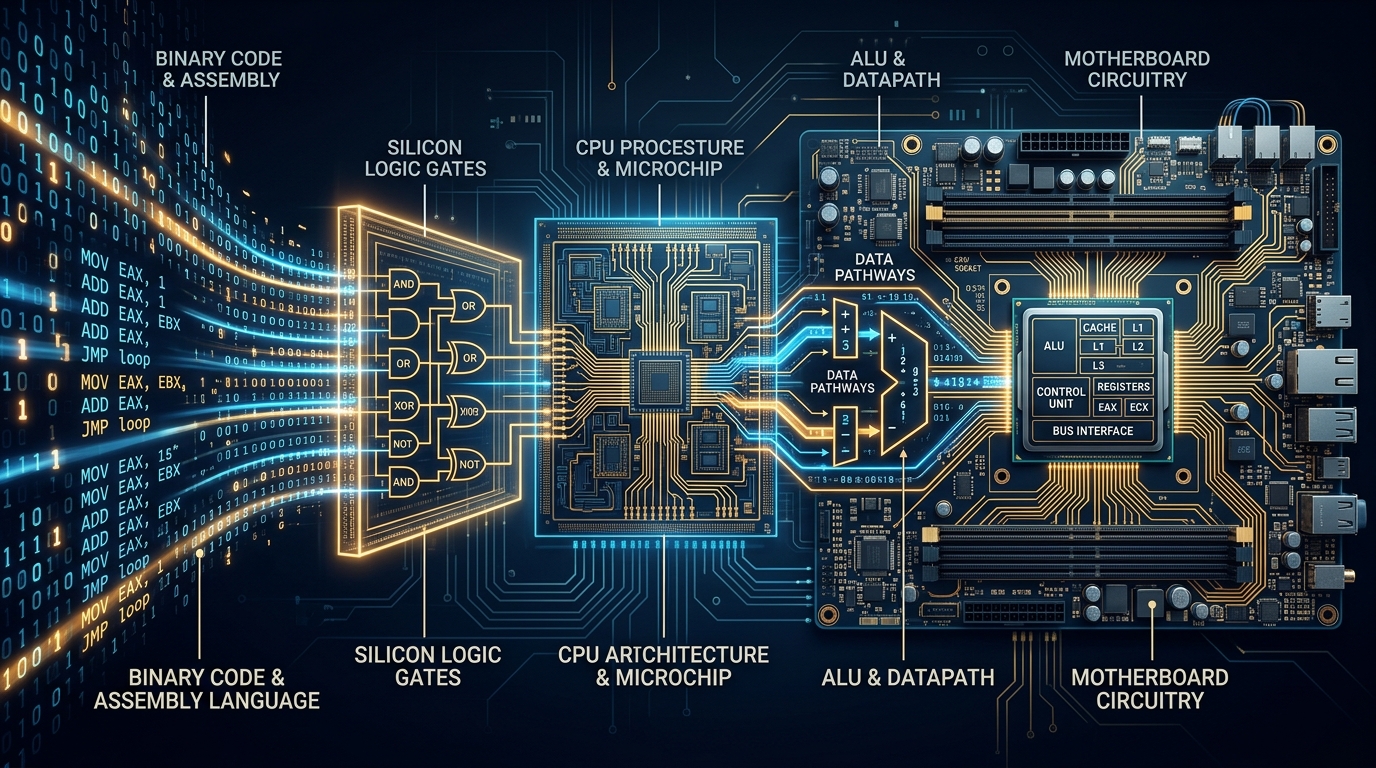
Platform: Udemy | Course title: Build a Computer From Scratch: Binary to CPU to Assembly
Format: MP4 (H.264, 1920x1080, AAC 44.1 kHz, stereo) | Lectures: 53 lessons
Duration: 11 hours 13 minutes | Size: 5.4 GB (split into 3 parts) | Language: English
Category: eLearning / Tutorials | Topics: computer architecture, CPU design, digital logic, and Assembly
Build a Computer From Scratch: Binary to CPU to Assembly is a hands-on course about how computers work at a fundamental level.
Starting with binary digits, the course moves through logic gates and transistors, then builds an ALU, memory, a data bus, an instruction set architecture (ISA), a control unit, and a complete computer capable of running Assembly programs.
Course details
- Platform: Udemy
- Format: MP4
- Video: H.264, 1920x1080 Full HD
- Audio: AAC, 44.1 kHz, 2-channel stereo
- Category: eLearning / Computer Science
- Language: English
- Lectures: 53
- Duration: 11 hours 13 minutes
- Size: 5.4 GB
- Key topics: binary arithmetic, logic gates, ALU, memory registers, CPU control unit, ARMv6, and Assembly
The path from a bit to a program
The course visually and conceptually follows the full engineering path:
Binary system ↓ Logic gates ↓ Adders ↓ ALU ↓ Memory and registers ↓ Bus ↓ ISA ↓ Control unit ↓ CPU ↓ Machine code ↓ Assembly program
Main topics covered
Binary number system
Start with zeros and ones. Learn how electronic circuits represent values and how calculations can be performed with binary signals:
- Convert between decimal, binary, and hexadecimal.
- Add and subtract binary numbers.
- Represent negative numbers with two's complement.
Digital logic and logic gates
Build more complex components from basic gates such as AND, OR, NOT, XOR, NAND, and NOR:
- Selectors and multiplexers (MUX).
- Half-adders and full adders.
- Connect adders into multi-bit structures.
- Visualize what happens in hardware when a processor receives a mathematical instruction.
Build an ALU
The Arithmetic Logic Unit (ALU) is a core part of a processor. See how logic components combine into a multi-bit ALU that supports addition, logic operations, and subtraction.
Memory and registers
For a computer to do useful work, it needs to store state:
- Latches and flip-flops.
- Hardware registers and sequential logic.
- RAM and ROM architecture.
- Addressing memory locations.
Bus architecture
The ALU, registers, and memory need a shared communication channel to exchange data:
- Manage data and address buses.
- Prevent conflicts on transmission lines.
- Understand clock synchronization.
Instruction Set Architecture and control unit
Hardware needs instructions. Learn how a CPU instruction set is defined and executed:
- Instruction formats and registers such as the Instruction Register and Program Counter.
- Conditional branching and status flags.
- Build a Control Unit that decodes instructions and directs components on each clock cycle.
Machine code and Assembly programming
After assembling a virtual computer, move on to programming:
- Write machine instructions.
- Develop and debug programs, such as a Fibonacci sequence calculator.
- Learn Assembly and its relationship to high-level languages such as C, Python, JavaScript, and Java.
- Explore ARMv6, memory-mapped I/O, and microcontrollers.
Who is this course for?
- Computer science and electrical engineering students who want a clear understanding of hardware.
- Software engineers and developers who want to look beneath the operating system and compiler.
- Embedded and IoT developers working with low-level microcontrollers.
- Aspiring hardware and VLSI engineers.
- Anyone preparing for computer architecture interviews.
- Curious learners who want to understand the processor instead of treating it as a black box.
Download the course
The course package is split into three parts, with a total size of 5.4 GB. Choose a download service:
FreeDL
ClicknUpload
Conclusion
Build a Computer From Scratch: Binary to CPU to Assembly is a comprehensive educational resource. It starts with binary digits and gradually builds up to a processor that can execute code. After the course, you will have a deeper understanding of how modern computers and software work.
macOS Tahoe Essential Training: Complete Course
A beginner-friendly course covering macOS Tahoe, system settings, apps, privacy, security, and Apple Intelligence features.
Bash Shell Scripting Bootcamp: Linux Automation with 50+ Projects
Learn Bash scripting through more than 50 practical projects. Automate Linux servers, file processing, services, and DevOps tasks.

Streaming Platforms for Movies, TV, Anime, and More: The Complete Guide
A comprehensive guide to 31 streaming categories in 2026, including movies, TV shows, anime, Asian dramas, film archives, live TV, sports, IPTV, and Smart TV apps.

Free Games, Retro Gaming, Emulation, ROMs, and Browser Games: The Complete Guide
A large directory of free games, emulation, retro consoles, ROM tools, indie projects, tabletop platforms, and hundreds of browser games.
[Udemy] Autodesk Fusion 360 (2025): Complete Beginner's Guide
A beginner-to-intermediate guide to 3D mechanical design with Autodesk Fusion 360 (2025 edition).

[Udemy] Interplanetary Spacecraft and Satellite Engineering
A complete guide to the design and technology behind interplanetary missions, rockets, and satellites.
Share your thoughts, questions, or tips about this article.